Irises in the Garden: A Gardener's Guide to Growing Irises for Season-Long Color in Zone 6
How We Use Bearded, Siberian, Japanese, Dutch, and Reblooming Irises at 19 Birch Lane
There are certain plants that become more than just flowers in a garden.
They become traditions.
For many gardeners, irises are one of those plants.
At 19 Birch Lane, irises represent everything we love about perennial gardening. They are long-lived, easy to share, endlessly collectible, and capable of providing extraordinary beauty with surprisingly little maintenance. Their blooms can be elegant and refined or dramatic and extravagant, depending on the variety, but all irises share one characteristic—they demand attention when they flower.
As our gardens continue to evolve into a botanical destination in Mid Coast Maine, irises have become an increasingly important part of our plant collections. We are continually adding new cultivars, experimenting with reblooming varieties, and exploring ways to extend the iris season from the earliest days of spring through autumn.
For gardeners in USDA Zone 6, few perennials offer the diversity, reliability, and garden value of irises.
Whether you're creating a cottage garden, a formal border, a pollinator garden, or a botanical collection, irises deserve a place in the landscape.
Why Irises Have Captivated Gardeners for Centuries
The story of irises stretches back thousands of years.
Named after Iris, the Greek goddess of the rainbow, these remarkable plants have been cultivated for centuries because of their extraordinary range of colors and forms.
Today there are thousands of registered iris cultivars, ranging from tiny dwarf species that bloom through late winter snow to towering reblooming bearded irises that flower again in autumn.
What makes irises so remarkable is their versatility.
Few perennials can offer:
Nearly year-round seasonal interest
Exceptional cold hardiness
Drought tolerance
Pollinator value
Architectural foliage
Generational longevity
Many iris plantings survive for decades, sometimes outliving the gardeners who originally planted them.
At 19 Birch Lane, we view irises as heirloom plants—living pieces of garden history that connect generations of gardeners through shared divisions and pass-along plants.
Building an Iris Collection for Continuous Bloom
One of the biggest mistakes gardeners make is planting only one type of iris.
Most people think of irises as a late spring flower.
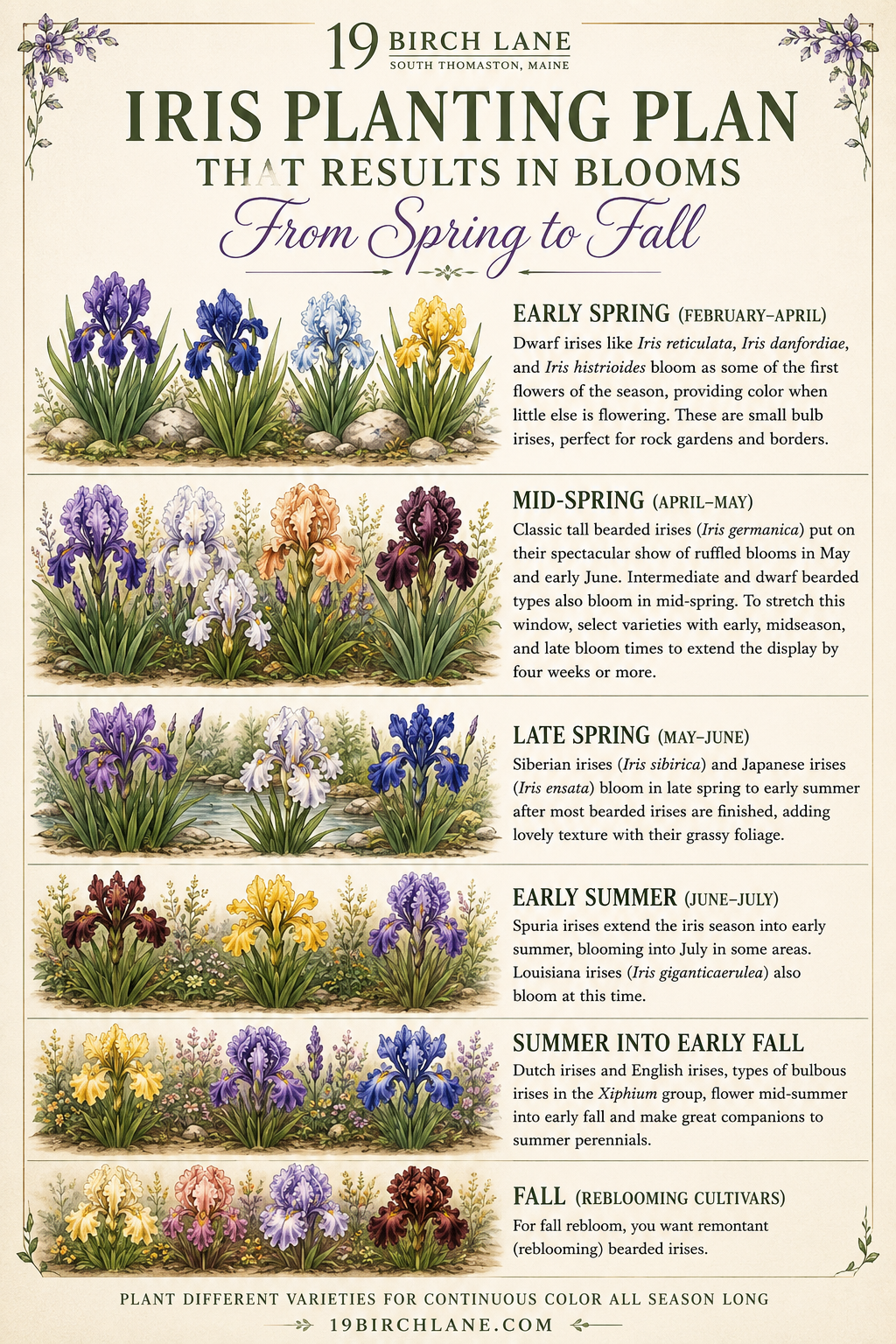
In reality, careful selection allows gardeners to enjoy iris blooms from February through October.
This is one of the reasons serious iris collectors become so passionate about the genus.
Different species bloom in succession, creating what is essentially a relay race of flowers throughout the growing season.
At 19 Birch Lane, our long-term goal is to create a collection that offers uninterrupted iris blooms across multiple garden spaces.
Early Spring Irises: The First Flowers of the Season
Iris reticulata, Iris danfordiae, and Iris histrioides
Long before most perennials awaken, these diminutive species emerge from frozen ground.
Often blooming alongside snowdrops and crocus, dwarf irises are among the earliest signs that winter is loosening its grip.
Their flowers may be small, but they possess extraordinary detail and vibrant color.
We especially love using these early bloomers:
Along garden pathways
In rock gardens
Beneath deciduous trees
Near entrances where early color can be appreciated
Because they bloom before many trees leaf out, they take full advantage of spring sunlight before fading gracefully into dormancy.
Bearded Irises: The Stars of Late Spring
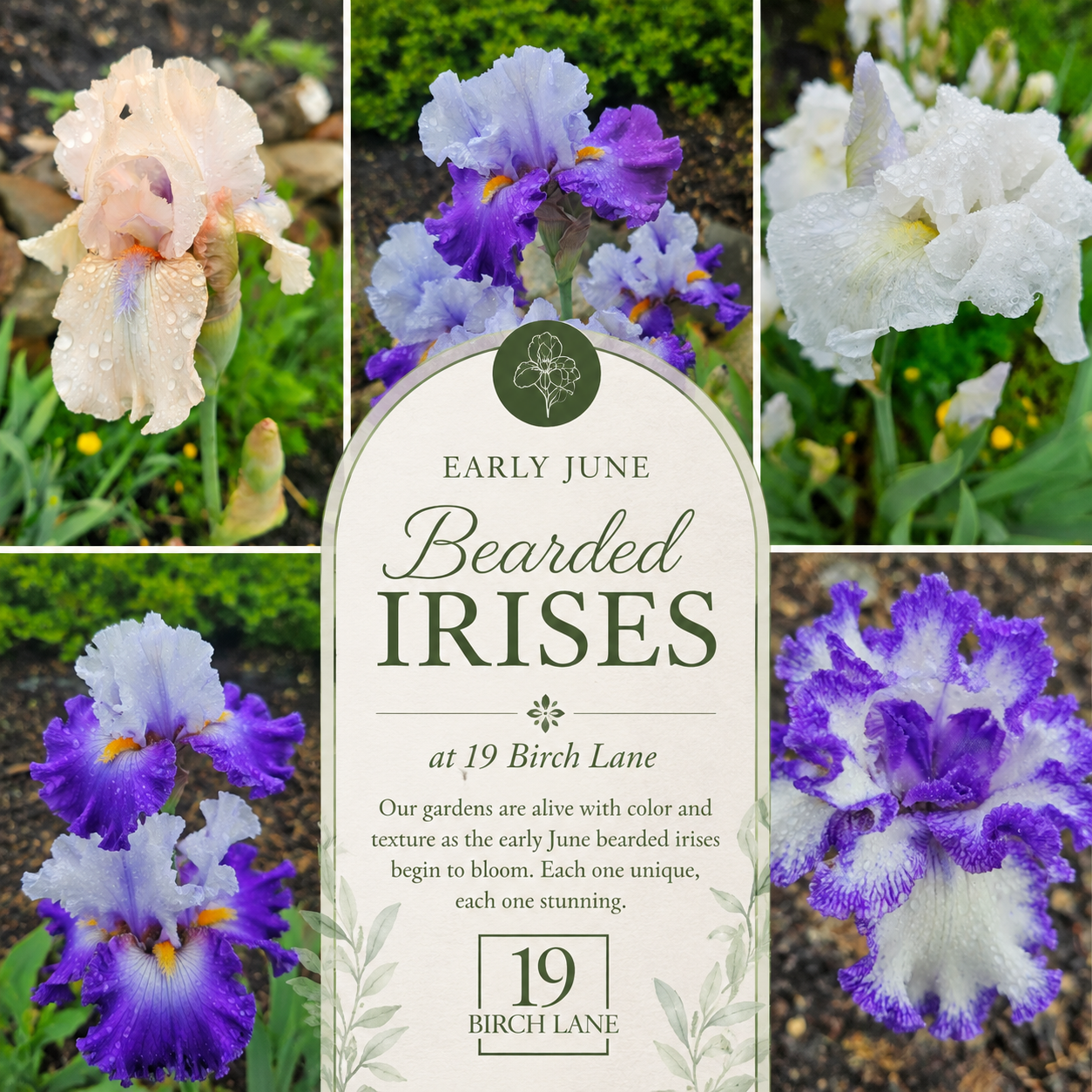
If there is a queen of the perennial border, it may very well be the Tall Bearded Iris (Iris germanica).
Their flowers are among the most sophisticated in the plant world.
Intricate veining.
Ruffled petals.
Fragrance.
Extraordinary color combinations.
Modern hybridizers have created flowers in virtually every color imaginable.
At 19 Birch Lane, bearded irises help bridge the transition between spring bulbs and early summer perennials.
We often combine them with:
Peonies
Catmint
Nepeta 'Walker's Low'
Salvia
Early roses
Alliums
The combination creates a layered display that feels both timeless and romantic.
Siberian Irises: Grace and Elegance in Motion
If bearded irises are dramatic performers, Siberian irises are refined dancers.
Their flowers appear to float above graceful clumps of grass-like foliage.
Unlike bearded irises, Siberians continue contributing beauty long after bloom season has passed.
Their foliage remains attractive throughout summer and into autumn, providing texture and movement in the garden.
At 19 Birch Lane, we use Siberian irises near:
Water features
Reflection pools
Pond edges
Moist borders
The combination of water and their upright foliage creates an especially naturalistic effect.
Japanese Irises: Living Works of Art
Few flowers stop visitors in their tracks like Japanese irises.
The blooms can reach incredible sizes and often resemble exotic orchids more than traditional garden perennials.
Japanese irises thrive in:
Consistently moist soil
Rich organic matter
Full sun
Because of their affinity for moisture, they are perfect companions for pond gardens and water features.
As our botanical gardens continue to expand, Japanese irises are becoming increasingly important in our water garden plantings.
The Future of Irises: Reblooming Cultivars
Perhaps the most exciting development in modern iris breeding has been the rise of reblooming varieties.
Historically, gardeners enjoyed a few weeks of iris flowers and then waited another year.
Today's reblooming cultivars change that equation entirely.
Varieties such as:
Pink Attraction
Best Bet
Champagne Elegance
Autumn Tryst
Rosalie Figge
Baby Blessed
can provide a second flush of flowers in late summer or early autumn.
For a botanical garden, this is invaluable.
Reblooming irises help extend seasonal interest while providing visitors with unexpected color later in the year.
Growing Irises in Coastal Maine (Zone 6)
One of the reasons irises perform so well at 19 Birch Lane is that many species appreciate the conditions found in Mid Coast Maine.
Our climate offers:
Cool spring temperatures
Moderate summer heat
Consistent air circulation
Ocean breezes
Well-defined seasonal transitions
The key to success is drainage.
If there is one lesson every iris grower should remember, it is this:
Irises prefer dry feet and sunny locations.
Many failures occur not because winters are too cold, but because soils remain too wet.
Dividing Irises: The Secret to Bigger Displays
Experienced gardeners know that dividing irises is not simply maintenance—it is an opportunity.
Every few years, mature clumps can be lifted, divided, and replanted.
The rewards include:
Increased flowering
Improved vigor
Better air circulation
New plants for other areas of the garden
And perhaps most importantly, divisions become gifts.
Some of the most cherished plants in any garden are those passed along from fellow gardeners.
At 19 Birch Lane, sharing plants remains one of our favorite traditions.
Why We Continue Collecting Irises at 19 Birch Lane
A true garden is never finished.
Each year brings new discoveries, new cultivars, and new opportunities to expand the collection.
Our iris collection continues to grow because every variety brings something unique:
A color we've never seen.
A fragrance we've never experienced.
A bloom season we've yet to extend.
As 19 Birch Lane evolves into a botanical destination in Mid Coast Maine, irises will continue to play a central role in the gardens.
Their beauty, history, resilience, and diversity embody everything we hope visitors experience when they walk our paths.
Because once you've fallen in love with irises, one variety is never enough.