
Kathy Ann Azalea
Rhododendron ‘Kathy Ann’ — A Pure White Evergreen Azalea for Woodland Gardens, Shrub Borders, Foundations, and Part-Shade Landscapes
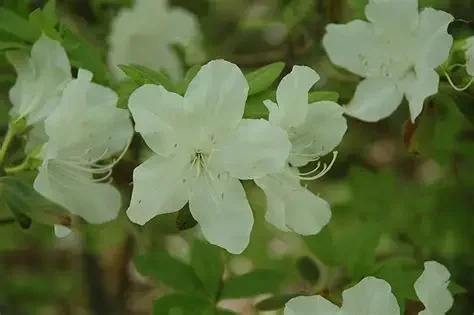
Kathy Ann Azalea
Rhododendron ‘Kathy Ann’ — A Pure White Evergreen Azalea for Woodland Gardens, Shrub Borders, Foundations, and Part-Shade Landscapes
Plant Overview
Common Name: Kathy Ann Azalea
Botanical Name: Rhododendron ‘Kathy Ann’
Also Known As: Girard’s Kathy Ann Azalea
Plant Type: Broadleaf Evergreen Flowering Shrub
Family: Ericaceae
Hybridizer: Girard Nurseries, Geneva, Ohio
USDA Hardiness Zones: Commonly listed as Zones 5–8
Primary Season of Interest: Spring
Bloom Time: Mid-Spring
Flower Color: Pure White
Kathy Ann Azalea is a compact evergreen azalea valued for its large, pure white spring flowers, dark green foliage, and useful size in the landscape.
The American Rhododendron Society’s historic plant registry identifies Kathy Ann as an evergreen azalea raised and introduced by Girard Nurseries of Geneva, Ohio, from a cross between two white seedlings. The original description records a semi-upright plant approximately 3 feet tall by 2½ feet wide with pure white, flat-open, slightly waved flowers reaching approximately 3 inches across.
The Royal Horticultural Society recognizes the accepted name as Rhododendron ‘Kathy Ann’ and lists Rhododendron ‘Girard’s Kathy Ann’ as a synonym.
Its combination of white flowers, evergreen foliage, compact growth and tolerance of partially shaded conditions makes Kathy Ann particularly useful in woodland gardens, foundation plantings, shrub borders and azalea collections.
Why We Grow It at 19 Birch Lane
Kathy Ann brings one of the most useful colors in garden design: pure white.
White flowers can brighten partially shaded areas while creating visual separation between stronger colors such as pink, red and purple.
For the developing gardens at 19 Birch Lane, Kathy Ann also provides an opportunity to demonstrate how evergreen azaleas can contribute more than a short spring flowering period.
Visitors can observe:
Evergreen versus deciduous azaleas
Spring flowering cycles
Acid-loving plant culture
Woodland garden design
Evergreen structure
Cultivar selection
Flower form and size
The history of American azalea breeding
Kathy Ann is particularly interesting botanically because it originated with Girard Nurseries, an important American breeder of evergreen azaleas.
Quick Facts
Common Name: Kathy Ann Azalea
Botanical Name: Rhododendron ‘Kathy Ann’
Synonym: Girard’s Kathy Ann Azalea
Family: Ericaceae
Plant Type: Broadleaf Evergreen Flowering Shrub
Hybridizer: Girard Nurseries
Origin: Cultivated hybrid
USDA Hardiness Zones: Commonly listed as 5–8
Mature Height: Approximately 3–4 feet under typical landscape conditions
Mature Width: Approximately 3–4 feet
Growth Habit: Semi-Upright, Spreading, Well-Branched
Bloom Time: Mid-Spring
Flower Color: Pure White
Flower Size: Up to approximately 3 inches
Flower Form: Flat-open to funnel-shaped, slightly waved
Foliage: Dark Green
Sun Exposure: Part Shade to filtered sun
Water Needs: Moderate; consistent moisture preferred
Soil: Acidic, organically rich and well-drained
Maintenance: Low to Moderate
Woodland Garden: Excellent
Foundation Planting: Excellent
Mass Planting: Excellent
Evergreen Interest: Yes
The original American Rhododendron Society description records Kathy Ann at approximately 3 feet by 2½ feet, while contemporary horticultural references commonly list mature landscape plants around 3–4 feet.
Growing Conditions
Light Requirements
Kathy Ann Azalea performs well in:
Part shade
Filtered sunlight
Woodland-edge conditions
Morning sun
Locations protected from intense afternoon sun
In Midcoast Maine, a site receiving morning sunlight followed by some afternoon protection can provide a particularly favorable balance.
Protection from harsh winter wind is also beneficial for evergreen azaleas because their foliage continues losing moisture during winter.
Soil Requirements
Kathy Ann prefers the acidic growing conditions characteristic of azaleas and rhododendrons.
The ideal soil is:
Acidic
Rich in organic matter
Moist but well-drained
Loose enough to provide good root aeration
Heavy, compacted or constantly saturated soil should be avoided.
Azaleas develop relatively shallow root systems, making soil preparation especially important.
Before planting in questionable conditions, testing the soil pH is preferable to automatically adding acidifying products.
Water Requirements
Kathy Ann prefers relatively consistent soil moisture, particularly during establishment.
During the first growing seasons:
Water deeply when rainfall is inadequate.
Monitor moisture during summer drought.
Avoid allowing the root zone to dry completely.
Avoid waterlogged soil.
Mulch around the root zone to conserve moisture.
Once established, plants should still receive supplemental water during prolonged dry periods.
Flower Characteristics
The defining feature of Kathy Ann is its large pure white flowers.
Flower Features
Pure white coloration
Approximately 3 inches across
Slightly waved edges
Large flowers relative to the foliage
Abundant spring display
Strong contrast against dark foliage
The original American Rhododendron Society description characterized the flowers as pure white, flat-open and slightly waved, reaching approximately 3 inches across.
This large flower size can make Kathy Ann particularly striking when planted in groups.
Foliage Characteristics
Kathy Ann belongs to the evergreen azalea group.
Its relatively small green leaves remain on the plant through much of the year, giving the shrub greater structural value than a purely deciduous flowering shrub.
Winter foliage appearance can vary with temperature, exposure and local growing conditions.
Some evergreen azaleas may show bronzing or other color changes during cold weather.
Cold Hardiness in Maine
Kathy Ann is commonly listed for approximately USDA Zones 5–8, making it potentially suitable for many Maine gardens, particularly protected Zone 6 locations.
At 19 Birch Lane, winter performance will also depend on the plant's microclimate.
For northern gardens, consider:
Protection from prevailing winter winds
Mulching the root zone
Avoiding exposed locations
Maintaining adequate moisture before winter
Providing some protection from intense winter sun
Avoiding low areas with poor drainage
A protected woodland edge or partially sheltered shrub border can provide a favorable environment.
Garden Uses
Kathy Ann can serve several landscape roles.
Recommended Uses
Shade Gardens
Foundation Plantings
Mixed Shrub Borders
Azalea Collections
Rhododendron Collections
White Gardens
Garden Entrances
Pathway Borders
Mass Plantings
Specimen Plantings
Pollinator-Friendly Gardens
Botanical Collections
Its manageable size allows Kathy Ann to provide significant spring color without overwhelming neighboring plants.
Using Kathy Ann in a Woodland Garden
Woodland and woodland-edge settings are among the strongest applications for this azalea.
The white flowers become especially noticeable against darker backgrounds.
Consider combining Kathy Ann with plants that provide contrasting foliage rather than relying entirely on flowers.
Hostas, ferns, hellebores and other shade-tolerant plants can extend the visual interest long after the azalea has finished flowering.
Using Kathy Ann in a White Garden
Kathy Ann is also a natural candidate for a white-themed garden.
White flowering plants can create a sense of continuity while differences in foliage shape, plant form and bloom time prevent the planting from becoming monotonous.
Rather than planting every white-flowering plant together, repeat white flowers periodically throughout the landscape.
Kathy Ann can become one of those repeating spring elements.
Companion Plants
Recommended companions include:
Hellebores
Brunnera
Astilbe
Heuchera
Tiarella
Bleeding Hearts
Other Azaleas
For 19 Birch Lane, Delaware Valley White Azalea should eventually be internally linked directly from this page so visitors can compare two white evergreen azaleas.
That comparison is useful both horticulturally and for the Plant Finder's internal-linking structure.
Care & Maintenance
Kathy Ann generally requires relatively straightforward care when planted in appropriate conditions.
Focus on:
Acidic soil
Good drainage
Consistent moisture
Organic mulch
Protection from severe winter exposure
Limited pruning
Maintaining healthy soil conditions
Correct siting is one of the most effective ways to reduce future maintenance.
Pruning Kathy Ann Azalea
When Should Kathy Ann Azalea Be Pruned?
If pruning is necessary, prune shortly after flowering.
Azaleas form flower buds for the following year's display on existing growth, so pruning too late can remove future flowers.
Routine heavy pruning should generally be unnecessary.
Instead, remove:
Dead branches
Damaged branches
Crossing branches
Weak growth
Occasional branches disrupting the natural form
Allowing Kathy Ann to maintain its natural semi-upright, spreading form generally produces the most attractive plant.
Mulching
Apply organic mulch over the root zone to help:
Retain moisture
Moderate soil temperatures
Reduce weed competition
Protect shallow roots
Gradually add organic material
Keep mulch away from direct contact with the stems and crown.
Approximately 2–3 inches is generally adequate.
Potential Problems
Azaleas can occasionally experience:
Lace bugs
Spider mites
Scale
Root rot
Leaf spot
Winter burn
Chlorosis
Drought stress
Yellow foliage during the growing season deserves attention.
Azaleas require acidic conditions to efficiently absorb certain nutrients. Soil that becomes too alkaline can contribute to chlorosis.
Rather than automatically applying fertilizer, evaluate soil pH, moisture and drainage first.
Why Gardeners Love Kathy Ann Azalea
✓ Large pure white flowers
✓ Evergreen foliage
✓ Compact landscape size
✓ Excellent woodland plant
✓ Performs well in part shade
✓ Useful foundation shrub
✓ Strong spring display
✓ Excellent contrast plant
✓ Works beautifully with shade perennials
✓ Fits naturally into azalea collections
✓ Provides year-round structure
✓ American-bred cultivar
✓ Valuable addition to white gardens
Plant Finder Details
Common Name: Kathy Ann Azalea
Botanical Name: Rhododendron ‘Kathy Ann’
Synonym: Girard’s Kathy Ann Azalea
Family: Ericaceae
Plant Type: Broadleaf Evergreen Flowering Shrub
Hybridizer: Girard Nurseries
USDA Hardiness Zones: Commonly 5–8
Mature Height: Approximately 3–4 feet
Mature Width: Approximately 3–4 feet
Growth Habit: Semi-Upright and Spreading
Sun Exposure: Part Shade / Filtered Sun
Water Requirements: Moderate
Soil Preference: Acidic, Organically Rich, Moist and Well-Drained
Bloom Season: Mid-Spring
Flower Color: Pure White
Flower Size: Up to approximately 3 inches
Foliage: Evergreen Green
Winter Interest: Yes
Foundation Use: Excellent
Woodland Garden: Excellent
White Garden: Excellent
📍 Where to Find Kathy Ann Azalea at 19 Birch Lane
Kathy Ann Azalea is particularly well suited to an azalea and rhododendron collection, woodland garden, partially shaded shrub border or another protected garden location where visitors can experience its large white flowers up close.
Add the exact 19 Birch Lane garden location here once its permanent location is confirmed.
Eventually, every Plant Finder listing should identify the actual garden or collection where visitors can find the plant.
That will turn the Plant Finder from an online plant encyclopedia into a digital companion for exploring the gardens at 19 Birch Lane.
🌸 Seasonal Interest Calendar
🌱 Early Spring
Evergreen foliage provides structure as flower buds begin developing.
🤍 Mid-Spring
This is Kathy Ann's primary season of interest.
Large pure white flowers cover the shrub, creating strong contrast against its darker foliage.
🌿 Early Summer
Flowering finishes and foliage becomes the primary feature.
If pruning is necessary, shortly after flowering is the appropriate time.
☀️ Summer
Green evergreen foliage provides structure behind summer-flowering perennials.
Monitor moisture during extended dry periods.
🍂 Fall
The foliage continues providing structure while neighboring deciduous plants begin changing color.
❄️ Winter
Evergreen foliage maintains garden structure, although cold temperatures and winter exposure can change foliage color.
Protection from drying winter winds is beneficial in colder northern climates.
🎓 Garden Design Tips from 19 Birch Lane
Kathy Ann demonstrates an important principle in garden design:
White doesn't have to be used as the main color to have a major visual impact.
White flowers can function as visual separators between stronger colors.
For example:
Kathy Ann Azalea + pink azalea + Kathy Ann Azalea + red azalea
The repeated white flowering shrubs can prevent neighboring colors from visually blending together.
For a woodland combination:
Kathy Ann Azalea + Hosta + Ferns + Hellebores + Brunnera
The azalea supplies the spring flower display while foliage plants continue carrying the planting through summer.
For a more architectural combination:
Kathy Ann Azalea + Japanese Maple + Ferns + Hydrangea
This creates multiple layers of height, texture and seasonal interest.
🌿 Plants That Grow Well with Kathy Ann Azalea at 19 Birch Lane
Recommended companions include:
Ferns
Hellebores
Brunnera
Astilbe
Heuchera
Tiarella
Bleeding Hearts
Japanese Forest Grass
Other evergreen azaleas
As these plants receive their own Plant Finder pages, their names should become internal links.
This creates topical relationships that help visitors, search engines and AI systems understand how the individual Plant Finder pages relate to one another.
Frequently Asked Questions
What is Kathy Ann Azalea?
Kathy Ann is an evergreen azalea developed and introduced by Girard Nurseries. It is particularly known for its large pure white spring flowers.
What is the botanical name of Kathy Ann Azalea?
The accepted botanical name is Rhododendron ‘Kathy Ann’. The name Rhododendron ‘Girard’s Kathy Ann’ is also used as a synonym.
Who developed Kathy Ann Azalea?
Kathy Ann was raised and introduced by Girard Nurseries of Geneva, Ohio.
What color is Kathy Ann Azalea?
Its flowers are pure white.
How large are Kathy Ann Azalea flowers?
The original cultivar description records flowers reaching approximately 3 inches across.
How large does Kathy Ann Azalea get?
Expect approximately 3–4 feet tall and wide under typical landscape conditions, although size varies with climate, age and growing conditions.
Is Kathy Ann Azalea evergreen?
Yes. Kathy Ann is classified as an evergreen azalea.
When does Kathy Ann Azalea bloom?
Kathy Ann flowers in spring, with exact timing depending on climate and seasonal temperatures.
Does Kathy Ann Azalea grow in shade?
Kathy Ann performs particularly well in part shade and filtered light. Dense, deep shade may reduce flowering.
What soil does Kathy Ann Azalea prefer?
It prefers acidic, organically rich, moist but well-drained soil.
Can Kathy Ann Azalea grow in Maine?
Yes, Kathy Ann is commonly listed for USDA Zones 5–8, putting much of Maine's milder garden areas within or near its reported range. Protected placement becomes increasingly important in colder and more exposed locations.
Is Kathy Ann Azalea suitable for Zone 6?
Yes. Zone 6 falls within its commonly reported hardiness range.
When should Kathy Ann Azalea be pruned?
If pruning is needed, prune shortly after flowering to minimize removal of developing flower buds for the following season.
Is Kathy Ann Azalea good for a woodland garden?
Yes. Its evergreen foliage, white spring flowers and preference for filtered light make it particularly useful in woodland and woodland-edge gardens.
What plants look good with Kathy Ann Azalea?
Hostas, ferns, hellebores, brunnera, astilbe, Japanese maples, hydrangeas and other azaleas can provide complementary foliage, color and seasonal interest.
What's the difference between Kathy Ann and Delaware Valley White Azalea?
Both are white-flowering evergreen azaleas suitable for partially shaded gardens. Kathy Ann is a Girard Nurseries introduction characterized in its original cultivar description by pure white flowers reaching approximately 3 inches across. Maintaining separate Plant Finder pages allows visitors to compare their individual flower characteristics, growth habits and performance at 19 Birch Lane.
Botanical Garden Notes
Kathy Ann has particular value in a botanical collection because its documented history connects it with American azalea breeding.
The American Rhododendron Society's registry records it as an evergreen azalea produced from two white seedlings and raised and introduced by Girard Nurseries in Geneva, Ohio.
Kathy Ann was also subsequently used in breeding. For example, the registered evergreen azalea ‘Mitey White’ resulted from a cross between Kathy Ann and ‘Clara Marie’.
This gives visitors an opportunity to learn about:
Evergreen azalea breeding
Cultivar selection
Plant parentage
American nursery history
Acid-loving plant culture
Woodland garden design
Evergreen versus deciduous azaleas
How cultivars become part of later breeding programs