
Pink Delight Butterfly Bush (Buddleja davidii ‘Pink Delight’)
A Fast-Growing Butterfly Bush with Fragrant Bright Pink Flowers from Summer into Fall
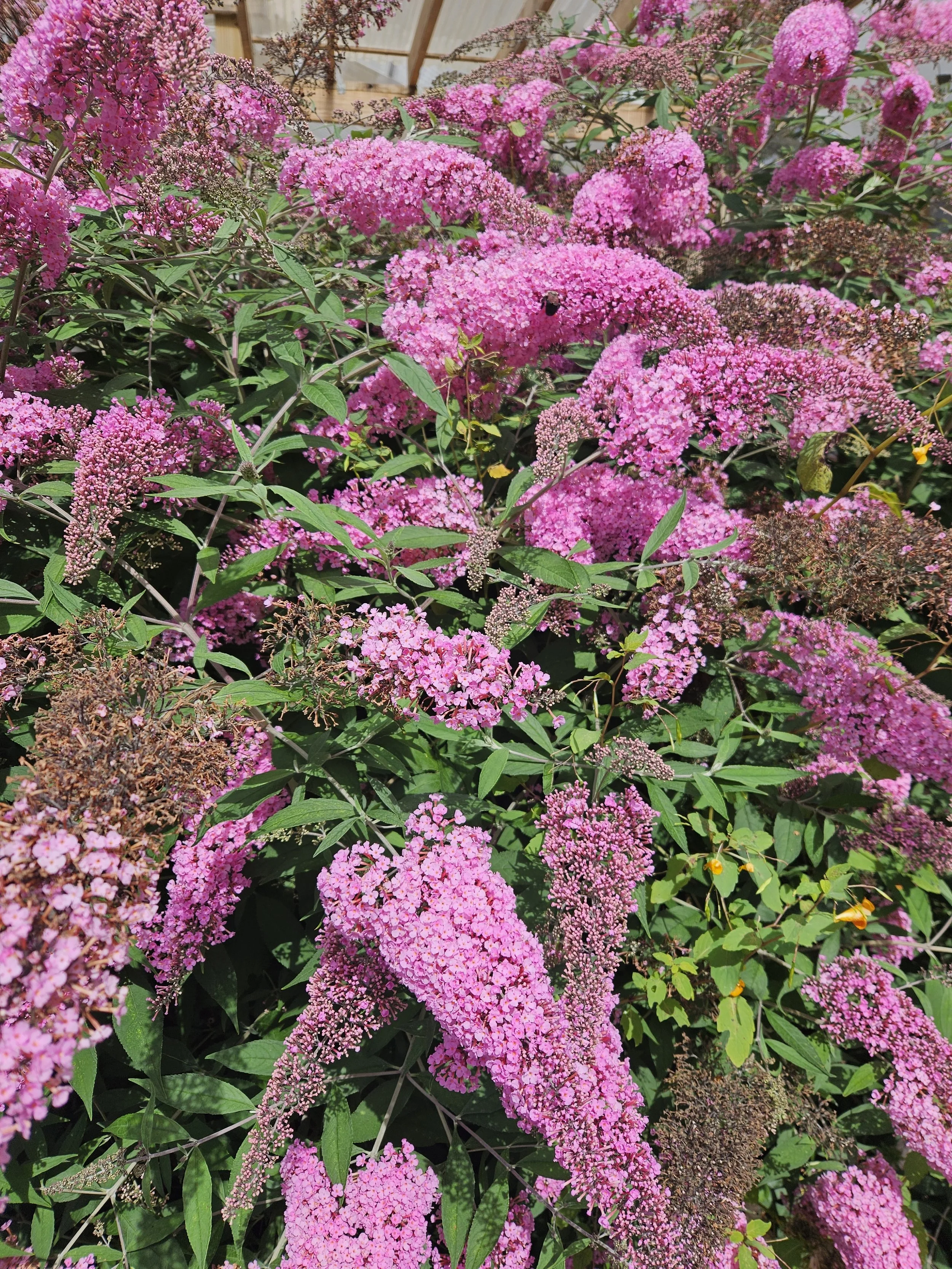
Pink Delight Butterfly Bush (Buddleja davidii ‘Pink Delight’)
A Fast-Growing Butterfly Bush with Fragrant Bright Pink Flowers from Summer into Fall
Plant Overview
Common Name: Pink Delight Butterfly Bush
Botanical Name: Buddleja davidii ‘Pink Delight’
Plant Type: Deciduous Flowering Shrub
Hardiness Zones: USDA Zones 5–9
Primary Season of Interest: Summer through Fall
Pink Delight Butterfly Bush is a vigorous flowering shrub prized for its large, conical clusters of fragrant bright pink flowers, gray-green foliage, and extended summer-to-fall bloom season.
Growing quickly to approximately 6–8 feet tall and 4–6 feet wide, ‘Pink Delight’ develops a graceful vase-shaped habit that gives it enough presence to serve as either a flowering accent or a background shrub within a large perennial planting.
The abundant pink flower clusters provide excellent seasonal color while also attracting pollinators into the garden.
Its combination of fragrance, fast growth, long flowering season, deer and rabbit resistance, and relatively easy care makes it especially useful in sunny perennial borders, cutting gardens, pollinator plantings, and larger containers.
In colder portions of its growing range, the top growth may die back during winter before returning vigorously from the roots in spring.
Why We Grow It at 19 Birch Lane
At 19 Birch Lane, Pink Delight Butterfly Bush fits particularly well into our goal of designing gardens that remain colorful and active well beyond the traditional early-summer peak.
Its summer-to-fall flowers help extend the flowering season while providing additional resources for pollinators.
The bright pink blooms also bring a different color profile to a pollinator planting than the blues and purples often associated with plants such as Catmint, Russian Sage, Salvia, and Caryopteris.
That contrast gives us the opportunity to create layered combinations where individual plants complement one another rather than blending into a single mass of color.
Pink Delight is also large enough to provide meaningful structure within a garden.
Rather than thinking of it only as a flowering shrub, we can use it as part of the backbone of a sunny perennial border, with smaller perennials planted around and in front of it.
Quick Facts
Botanical Name: Buddleja davidii ‘Pink Delight’
Common Name: Pink Delight Butterfly Bush
Plant Type: Deciduous Flowering Shrub
USDA Hardiness Zones: 5–9
Mature Height: 6–8 feet
Mature Spread: 4–6 feet
Growth Rate: Fast
Growth Habit: Vase-Shaped
Bloom Time: Summer through Fall
Flower Color: Bright Pink
Flower Form: Conical Clusters
Fragrance: Fragrant
Foliage Color: Gray-Green
Sun Exposure: Full Sun
Water Needs: Moderate
Soil: Fertile, Well Drained
Maintenance: Easy
Waterwise: Yes Once Established
Pollinator Friendly: Yes
Deer Resistant: Yes
Rabbit Resistant: Yes
Cut Flower: Yes
Container Friendly: Yes
Growing Conditions
Light Requirements
Pink Delight Butterfly Bush performs best in:
Full Sun
Open Sunny Borders
Locations Receiving Strong Direct Sunlight
Full sun helps encourage:
Abundant flowering
Stronger stems
Better overall form
More compact growth
Greater flower production
For best performance, avoid planting Butterfly Bush in heavily shaded locations.
Soil Requirements
Pink Delight prefers soil that is:
Fertile
Well Drained
Moderately Moist During Establishment
Good drainage is particularly important.
Avoid planting in sites where water remains around the roots for extended periods.
Water Requirements
Pink Delight has moderate water requirements.
During the First Growing Season
Water deeply and regularly.
Encourage development of an extensive root system.
Avoid severe drought stress.
Once Established
Reduce watering frequency.
A practical approach is to water when the top several inches of soil have dried.
Established plants become increasingly waterwise and can tolerate periods of dry weather better than many moisture-loving flowering shrubs.
Flower Characteristics
Pink Delight produces showy conical clusters of bright pink flowers from summer into fall.
Flower Features
Bright pink coloration
Conical flower clusters
Fragrant
Showy
Long flowering period
Attractive to pollinators
Suitable for cutting
The combination of fragrance and vivid color makes the flowers particularly effective when the shrub is positioned where visitors can approach it closely.
Foliage Characteristics
Pink Delight develops attractive gray-green foliage that provides a softer background for its bright flowers.
Foliage Features
Gray-green coloration
Soft visual texture
Strong contrast with pink blooms
Useful neutral foliage in mixed plantings
The subdued foliage allows the flowers to remain the dominant visual feature of the plant.
Pollinator Benefits
Pink Delight Butterfly Bush is valuable for gardens designed to attract pollinators.
Its numerous fragrant flowers provide nectar during its summer-to-fall flowering period.
Garden Benefits
Attracts Pollinators
Extends the Flowering Season
Provides Summer Nectar
Provides Late-Season Floral Resources
Works Well in Pollinator-Focused Borders
At 19 Birch Lane, we recommend using Butterfly Bush as one component of a diverse pollinator planting rather than relying on one species alone.
Combining it with plants that flower earlier and later helps create a more continuous succession of bloom.
Deer & Rabbit Resistance
Pink Delight is considered resistant to both:
Deer
Rabbits
This makes it particularly useful in gardens where browsing pressure can make growing flowering shrubs difficult.
No plant should be considered completely wildlife-proof, but Butterfly Bush is generally a less preferred choice for browsing animals.
Drought & Waterwise Value
Once established, Pink Delight can tolerate reduced watering and is considered waterwise.
This makes it useful in:
Sunny Borders
Hot Garden Areas
Lower-Water Landscapes
Large Perennial Beds
Drought-Conscious Plantings
Regular watering remains important during the first growing season.
Garden Uses
Pink Delight Butterfly Bush can fill several important landscape roles.
Recommended Uses
Pollinator Gardens
Butterfly Gardens
Perennial Borders
Mixed Shrub Borders
Cottage Gardens
Cutting Gardens
Fragrance Gardens
Wildlife Gardens
Background Plantings
Accent Plantings
Large Containers
Sunny Foundation Plantings
Botanical Collections
Because it can reach six to eight feet tall, allow enough room for the shrub to mature naturally.
Using Pink Delight as a Background Plant
Pink Delight is particularly effective at the rear of a large perennial border.
Its height creates a flowering backdrop for lower-growing plants such as:
Butterfly Weed
Sedum
Asters
This layered approach helps create a garden that feels deeper and more established.
Companion Plants
The supplied companion recommendations include several excellent pollinator-friendly plants.
Recommended Companion Plants
Aster
Coneflower (Echinacea)
Butterfly Weed (Asclepias)
Salvia
Additional plants within the 19 Birch Lane palette that can create attractive combinations include:
Catmint
Bee Balm
Sedum ‘Autumn Joy’
Black-Eyed Susan
Joe Pye Weed
Goldenrod
Ornamental Grasses
Caryopteris
Whenever Plant Finder profiles exist for companion plants, link each name directly to the corresponding page.
Care & Maintenance
Pink Delight is relatively easy to maintain.
Its most important requirements are:
Plenty of sunlight
Good drainage
Adequate water during establishment
Seasonal pruning
Removal of spent flowers when desired
Deadheading Pink Delight Butterfly Bush
Removing spent flowers can help encourage continued flowering.
Deadheading also keeps the shrub looking cleaner during its long bloom season.
To deadhead:
Locate the faded flower cluster.
Follow the stem down to healthy leaves or a side shoot.
Remove the spent flower just above that point.
Regular deadheading during the growing season can help maintain a fresh appearance and promote additional blooms.
Pruning Pink Delight Butterfly Bush
When Should Pink Delight Butterfly Bush Be Pruned?
Pruning depends partly on winter climate.
In cold climates where winter damages the upper growth, wait until spring to determine which stems remain alive.
In warmer parts of its range, pruning can be done in late fall or early spring.
For a cold-winter garden such as Midcoast Maine, early spring pruning is the safer approach.
How to Prune Butterfly Bush
In spring:
Wait until severe winter weather has passed.
Inspect the stems for signs of life.
Remove dead or damaged wood.
Cut the plant back as necessary to encourage vigorous new growth.
Remove weak or crossing stems.
Maintain the shrub's natural vase-shaped habit.
Cold-Climate Considerations for Maine Gardens
Pink Delight is listed for USDA Zones 5–9.
In colder locations, including portions of Maine, the above-ground stems may die back during severe winters.
This does not necessarily mean the plant has died.
The root system may remain alive and produce vigorous new shoots in spring.
For northern gardens:
Plant in full sun.
Choose a well-drained location.
Avoid wet winter soil.
Wait until spring before removing apparently dead stems.
Look for new growth emerging from the crown or lower stems.
Because Pink Delight grows rapidly, plants that experience winter dieback can still regain substantial size during a single growing season.
Fertilizing
Feed Pink Delight in spring as new growth begins.
A balanced fertilizer can help support:
Healthy foliage
Vigorous stems
Strong flowering
Avoid excessive fertilization.
Too much nitrogen can encourage leafy growth at the expense of flower production.
Container Growing
Pink Delight can be grown in a container, but its mature size means the container should be substantial.
Keep in mind that a mature plant may reach:
6–8 feet tall
4–6 feet wide
For container culture:
Use a large container.
Provide excellent drainage.
Position in full sun.
Water regularly.
Monitor moisture more frequently than with in-ground plants.
In colder climates, roots grown above ground in containers can experience lower temperatures than roots planted directly in garden soil.
Cut Flower Use
Pink Delight works well in fresh-cut arrangements.
Its fragrant pink flower clusters add:
Height
Color
Fragrance
Soft texture
Good floral companions include:
Hydrangea
Asters
Coneflowers
Goldenrod
Sedum
Ornamental Grasses
Landscape Design Ideas
Pink Delight works particularly well when used as a vertical flowering anchor.
Try it:
At the back of a perennial border
In groups within large pollinator gardens
Along sunny garden edges
Behind Butterfly Weed
With ornamental grasses
In cottage-style plantings
Near a cutting garden
As a large flowering accent
Near seating areas where fragrance can be appreciated
Its pink flowers work particularly well with:
Purple
Blue
White
Silver
Burgundy
Soft Yellow
Why Gardeners Love Pink Delight Butterfly Bush
✔ Bright pink flowers
✔ Fragrant blooms
✔ Long summer-to-fall flowering season
✔ Fast growing
✔ Reaches 6–8 feet tall
✔ Excellent pollinator plant
✔ Deer resistant
✔ Rabbit resistant
✔ Waterwise once established
✔ Easy care
✔ Excellent cut flower
✔ Attractive gray-green foliage
✔ Strong background shrub
✔ Good for containers
✔ Hardy in Zones 5–9
Plant Finder Details
Botanical Name: Buddleja davidii ‘Pink Delight’
Common Name: Pink Delight Butterfly Bush
Plant Type: Deciduous Flowering Shrub
USDA Hardiness Zones: 5–9
Mature Height: 6–8 feet
Mature Spread: 4–6 feet
Growth Rate: Fast
Growth Habit: Vase-Shaped
Bloom Time: Summer through Fall
Flower Color: Bright Pink
Flower Form: Conical Clusters
Fragrance: Fragrant
Foliage Color: Gray-Green
Sun Exposure: Full Sun
Water Requirements: Moderate
Soil Requirements: Fertile, Well Drained
Pollinator Friendly: Yes
Deer Resistant: Yes
Rabbit Resistant: Yes
Waterwise: Yes Once Established
Cut Flower: Yes
Container Friendly: Yes
Deadheading: Encourages Continued Bloom
Feeding: Spring
Cold Climate Habit: May die back to ground and regrow from roots
📍 Where to Find This Plant at 19 Birch Lane
Pink Delight Butterfly Bush is especially well suited to large sunny areas where its six- to eight-foot mature height can be appreciated without crowding neighboring plants.
Potential planting areas could include:
Large Perennial Borders
Pollinator-Focused Plantings
Butterfly Garden Areas
Cutting Garden
Sunny Mixed Borders
Wildlife-Friendly Plantings
The exact permanent location at 19 Birch Lane has not yet been provided for this Plant Finder entry.
Once its location is confirmed, this section should be updated with the specific garden name so visitors can use the Plant Finder to locate Pink Delight within the living collections.
🌸 Seasonal Interest Calendar
🌱 Spring
New growth begins as soil and air temperatures warm.
In colder climates, growth may emerge from the base after the previous year's stems have died back.
Spring is the best time to evaluate winter damage and perform necessary pruning.
☀️ Early Summer
Fast-growing stems create a substantial vase-shaped shrub covered in gray-green foliage.
Flower buds begin developing.
🦋 Summer
Bright pink fragrant flower clusters begin opening.
Pollinator activity increases as flowering reaches its seasonal peak.
🌺 Late Summer
Flowering continues.
Removing spent flowers can encourage additional blooms and maintain a tidier appearance.
🍂 Fall
Flowers may continue into fall, helping extend both garden color and pollinator activity later in the season.
❄️ Winter
Pink Delight becomes dormant.
In cold winter areas, some or all of the upper stems may die back, with new growth emerging from the roots the following spring.
🎓 Garden Design Tips from 19 Birch Lane
At 19 Birch Lane, Pink Delight would work best as a large flowering backdrop rather than a small accent plant.
Its six- to eight-foot mature height gives it enough visual weight to anchor the back of a substantial perennial border.
One particularly effective combination would be:
Pink Delight Butterfly Bush + purple Catmint + orange Butterfly Weed + white Coneflower + ornamental grasses.
This combination provides:
Strong color contrast
Multiple flower forms
Different foliage textures
Extended bloom
Pollinator value
Another attractive approach is pairing its bright pink flowers with silver foliage from Artemisia or the blue-purple flowers of Russian Sage.
For a softer garden composition, combine it with:
Pale pink flowers
White Hydrangeas
Lavender Salvia
Blue Catmint
Because Pink Delight grows rapidly and can become four to six feet wide, avoid squeezing it into a narrow border.
Giving the shrub adequate space allows its natural vase shape to become part of the design.
🌿 Plants That Grow Well with Pink Delight Butterfly Bush at 19 Birch Lane
Recommended companions include:
Asters
Coneflower
Butterfly Weed
Salvia
Russian Sage
Catmint
Bee Balm
Black-Eyed Susan
Sedum ‘Autumn Joy’
Joe Pye Weed
Goldenrod
Caryopteris
Ornamental Grasses
Whenever a companion already has a Plant Finder listing, link its name directly to the corresponding page.
This allows visitors to explore related plants based on pollinator value, growing conditions, color, and bloom season while creating stronger internal connections throughout 19BirchLane.com.
Frequently Asked Questions
What is Pink Delight Butterfly Bush?
Pink Delight is a fast-growing deciduous Butterfly Bush with fragrant bright pink flowers and gray-green foliage.
What is the botanical name of Pink Delight Butterfly Bush?
Its botanical name is Buddleja davidii ‘Pink Delight’.
Is it spelled Buddleja or Buddleia?
The botanical genus is commonly seen written both ways in gardening references. For this Plant Finder listing, the botanical name is presented as Buddleja davidii ‘Pink Delight’.
How tall does Pink Delight Butterfly Bush grow?
Pink Delight typically reaches approximately 6–8 feet tall.
How wide does Pink Delight grow?
A mature shrub generally spreads approximately 4–6 feet.
Is Pink Delight a compact Butterfly Bush?
Although described as having a relatively compact habit for its form, Pink Delight is still a substantial shrub that can reach six to eight feet tall. It should be given generous space.
When does Pink Delight Butterfly Bush bloom?
It flowers from summer into fall.
What color are Pink Delight flowers?
The flowers are bright pink.
Are Pink Delight flowers fragrant?
Yes. Its showy pink flower clusters are fragrant.
Does Pink Delight Butterfly Bush attract pollinators?
Yes. It is grown in part for its ability to attract pollinators during its summer-to-fall flowering season.
Does Butterfly Bush need full sun?
Yes. Pink Delight performs best in full sun.
Is Pink Delight drought tolerant?
Once established, it becomes relatively waterwise and can tolerate reduced watering compared with newly planted shrubs.
How often should Pink Delight Butterfly Bush be watered?
Water deeply and regularly during the first growing season. Once established, reduce watering frequency and water when the upper portion of the soil becomes dry.
What type of soil does Butterfly Bush prefer?
Pink Delight prefers fertile, well-drained soil.
Is Pink Delight deer resistant?
Yes. It is considered deer resistant.
Is Pink Delight rabbit resistant?
Yes. It is also considered rabbit resistant.
Should Pink Delight Butterfly Bush be deadheaded?
Removing spent flowers can help promote continued blooming and keeps the shrub looking tidy.
When should Pink Delight Butterfly Bush be pruned?
In colder climates, prune in early spring after winter damage can be assessed.
Can Pink Delight Butterfly Bush survive Maine winters?
Pink Delight is listed for USDA Zones 5–9. In colder areas, the stems may die back to the ground while the roots survive and produce vigorous new growth in spring.
Why does my Butterfly Bush look dead after winter?
Cold temperatures may kill the upper stems. Wait for new spring growth from the lower stems or root crown before deciding that the plant has died.
Can Pink Delight be grown in a container?
Yes, but because the shrub can become quite large, use a substantial container and provide full sun, adequate water, and excellent drainage.
Is Pink Delight good for cut flowers?
Yes. The fragrant pink flower clusters can be used in fresh floral arrangements.
What grows well with Pink Delight Butterfly Bush?
Excellent companions include Asters, Coneflowers, Butterfly Weed, Salvia, Russian Sage, Catmint, Sedum, Goldenrod, Joe Pye Weed, and ornamental grasses.
Botanical Garden Notes
Pink Delight Butterfly Bush is a useful example of how flowering shrubs can provide both structural and seasonal functions within a perennial garden.
Its six- to eight-foot height gives it enough scale to form the background of a planting, while the bright pink flower clusters provide a strong ornamental display from summer into fall.
Within the developing botanical collections at 19 Birch Lane, Pink Delight can also help demonstrate the importance of succession of bloom.
A pollinator garden should not depend on a single species or flowering period. Instead, combining shrubs and perennials that flower at different times creates a longer sequence of nectar-producing plants across the growing season.
Pairing Butterfly Bush with plants such as Butterfly Weed, Coneflower, Bee Balm, Asters, Goldenrod, and Sedum can create a more diverse and seasonally layered planting.
For more great information check out our blog called In the Garden at 19 Birch Lane