
Japanese Stewartia (Stewartia pseudocamellia)
An Exceptional Four-Season Flowering Tree with Camellia-Like White Blooms, Brilliant Fall Color & Exfoliating Winter Bark
Japanese Stewartia (Stewartia pseudocamellia)
An Exceptional Four-Season Flowering Tree with Camellia-Like White Blooms, Brilliant Fall Color & Exfoliating Winter Bark
Plant Overview
Common Name: Japanese Stewartia
Other Common Names: Common Stewartia, Korean Stewartia, Natsu-tsubaki
Botanical Name: Stewartia pseudocamellia
Previously Known As: Stewartia grandiflora, Stewartia koreana
Plant Type: Deciduous Flowering Tree
Family: Theaceae
Native Range: Japan and Korea
Hardiness Zones: USDA Zones 5a–8b
Primary Seasons of Interest: Summer, Fall & Winter
Japanese Stewartia is an exceptional small- to medium-sized ornamental tree prized for providing interest across multiple seasons. White, camellia-like flowers appear during summer, brilliant foliage develops in fall, and beautifully exfoliating multicolored bark becomes a major feature of the winter landscape.
Typically developing an upright, pyramidal to oval form, Stewartia pseudocamellia may grow as either a single- or multi-trunked tree. Mature specimens can reach approximately 12–40 feet tall and 8–25 feet wide, although growth is relatively slow.
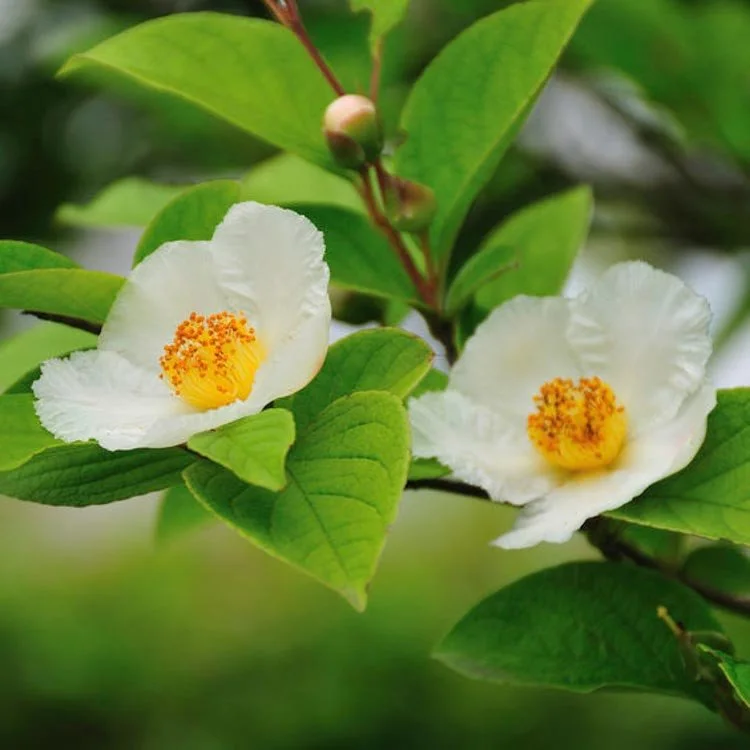
From June through August, approximately 2½-inch white flowers open individually among the dark green foliage. Five white petals surround prominent golden-yellow stamens, creating the resemblance to Camellia reflected in the species name pseudocamellia, meaning "false camellia."
As temperatures cool, the foliage can transform into combinations of yellow, orange, red, burgundy, and purple. After the leaves fall, exfoliating bark reveals a patchwork of gray, orange, reddish-brown, and lighter underlying bark.
This progression makes Japanese Stewartia a true four-season specimen tree.
Why We Grow Japanese Stewartia at 19 Birch Lane
Japanese Stewartia represents exactly the type of tree we want within the developing botanical collections at 19 Birch Lane: a plant that rewards visitors at several different times of year rather than during one brief flowering period.
The summer flowers are beautiful, but they are only part of the story.
Its changing fall foliage creates another display, followed by exfoliating bark that becomes increasingly visible once the garden enters winter dormancy.
This is particularly important as we continue developing 19 Birch Lane toward a destination that visitors can experience across a longer portion of the year.
Stewartia also gives us an opportunity to teach an important garden-design principle:
A great specimen tree should be selected for more than its flowers.
Bark, branching structure, foliage, fall color, mature form, and seasonal change can be just as important.
Quick Facts
Botanical Name: Stewartia pseudocamellia
Common Name: Japanese Stewartia
Other Names: Common Stewartia, Korean Stewartia, Natsu-tsubaki
Family: Theaceae
Plant Type: Deciduous Flowering Tree
Native Range: Japan and Korea
USDA Hardiness Zones: 5a–8b
Mature Height: Approximately 12–40 feet
Mature Spread: Approximately 8–25 feet
Growth Rate: Slow
Habit: Pyramidal to Oval; Often Multi-Stemmed or Multi-Trunked
Flowering Period: June through August
Flower Color: White with Golden-Yellow Centers
Flower Size: Approximately 2½ inches
Foliage: Dark Green
Fall Color: Yellow, Orange, Red, Burgundy & Purple
Bark: Exfoliating Gray, Orange & Reddish-Brown
Fruit: Small Green-to-Brown Capsules
Sun Exposure: Full Sun to Partial Shade
Soil: Moist, Organically Rich, Well Drained
Preferred Soil Texture: Loam or Sandy Soil
Soil pH: Acidic to Neutral
Drought Tolerance: Low
Pollinator Value: Flowers Attract Bees
Major Pest/Disease Problems: No Serious Problems Reported
Growing Conditions
Light Requirements
Japanese Stewartia grows in:
Full Sun
Partial Shade
Approximately 2–6 Hours of Direct Sun in Part-Shade Locations
6+ Hours of Direct Sun in Full-Sun Locations
In cooler northern climates, it can perform well with substantial sunlight when adequate soil moisture is maintained.
In hotter climates, protection from intense afternoon sun can be beneficial.
Soil Requirements
Japanese Stewartia prefers:
Moist Soil
Well-Drained Soil
Organically Rich Soil
Loamy Soil
Sandy Soil
Acidic to Neutral Soil
It is not particularly well suited to:
Heavy Clay
Rocky Soil
Very Dry Soil
Poorly Drained Sites
Good soil preparation is especially worthwhile because Stewartia can be difficult to transplant once established.
Water Requirements
Japanese Stewartia is not considered drought tolerant.
Maintain consistent moisture, particularly:
During establishment
During summer heat
During prolonged periods without rainfall
A layer of organic mulch can help conserve soil moisture and moderate root-zone temperatures.
Avoid allowing the soil to become chronically waterlogged.
The goal is moist but well-drained soil.
Cold-Climate Considerations for Maine Gardens
Japanese Stewartia is particularly interesting for 19 Birch Lane because it is hardy into USDA Zone 5 and is noted for tolerating the colder conditions associated with New England.
That makes it a potentially excellent specimen tree for Midcoast Maine.
Cold hardiness does not eliminate the importance of proper siting, however.
For northern gardens:
Protect the tree from harsh winter winds.
Maintain adequate soil moisture before winter.
Avoid exposed, excessively windy sites.
Provide good drainage.
Mulch the root zone without piling mulch against the trunk.
A protected location can be especially valuable while a young tree becomes established.
Flower Characteristics
Japanese Stewartia produces elegant Camellia-like flowers during summer.
Flower Features
White
Cup-Shaped
Approximately 2½ Inches Across
Usually Five Petals
Golden-Yellow Stamens
Solitary Flowers
Showy
Summer Blooming
Bee Attracting
The flowers generally appear from June through August.
Rather than producing one enormous synchronized bloom, individual flowers open over an extended period, creating a more refined seasonal display.
Why Are Stewartia Flowers Compared with Camellias?
Stewartia and Camellia belong to the same plant family, Theaceae.
Japanese Stewartia's white, cup-shaped flowers with prominent golden stamens have a distinctly Camellia-like appearance.
That relationship is reflected in the species name:
pseudocamellia = "false camellia."
Foliage Characteristics
Japanese Stewartia develops attractive dark green foliage during the growing season.
Leaf Features
Dark Green
Simple
Alternate
Elliptical to Obovate
Serrated Margins
Approximately 2–4½ Inches Long
Smooth Upper Surface
Small Tufts of Hair on the Undersides
The foliage creates an attractive green canopy throughout summer before undergoing its dramatic autumn transformation.
Fall Color
Fall is one of Japanese Stewartia's strongest seasons.
Depending on conditions, the foliage may develop shades of:
Yellow
Gold
Orange
Red
Burgundy
Purple
Individual trees can display several colors simultaneously.
This makes Stewartia valuable in landscapes where fall interest is an important part of the overall garden design.
Exfoliating Bark & Winter Interest
The bark may be the feature that ultimately distinguishes Japanese Stewartia from many other flowering trees.
As the tree matures, its bark exfoliates and peels away in irregular patches and strips.
Bark Colors Can Include
Gray
Light Gray
Light Brown
Orange
Reddish-Brown
Burgundy Tones
The newly exposed bark underneath is smoother, producing a patchwork effect across the trunk and larger branches.
Once the foliage drops, this bark becomes a major ornamental feature.
For a garden intended to remain interesting beyond summer, that is extremely valuable.
Fruit Characteristics
After flowering, Japanese Stewartia develops small hard seed capsules.
Fruit Features
Green when immature
Brown to copper-colored as they mature
Oval
Hard
Capsule-type fruit
Approximately 1 inch long
Fall interest
Although the fruit is less dramatic than the flowers, foliage, or bark, it contributes another botanical feature to observe through the season.
Pollinator & Wildlife Benefits
Japanese Stewartia flowers attract bees.
The summer flowering period makes the tree a useful addition to a garden containing a diversity of flowering trees, shrubs, and perennials.
At 19 Birch Lane, we prefer to view pollinator planting as an entire garden system rather than depending on any single plant.
Stewartia can therefore become one piece of a larger succession of flowering plants providing resources throughout the growing season.
Growth Habit
Japanese Stewartia is generally slow growing.
Its form may be described as:
Pyramidal
Oval
Upright
Erect
Ascending
Multi-Stemmed
Multi-Trunked
Dense to Somewhat Open
Lower branches may remain on the tree, particularly when it is allowed to develop naturally.
Because the bark is such an important feature, thoughtful pruning can eventually help reveal attractive trunks without destroying the tree's natural character.
Garden Uses
Japanese Stewartia is particularly well suited to locations where visitors can appreciate it throughout the year.
Recommended Uses
Specimen Tree
Woodland Garden
Asian-Inspired Garden
Cottage Garden
Pollinator Garden
Winter Garden
Patio Garden
Lawn Specimen
Along Walkways
Mixed Tree and Shrub Borders
Small Groups
Botanical Collections
Four-Season Gardens
Using Japanese Stewartia as a Specimen Tree
This is a tree that deserves to be seen.
Rather than hiding Japanese Stewartia at the back of a large planting, consider placing it where visitors can appreciate:
summer flowers → fall foliage → winter bark
Good locations include:
Near a garden path
Beside a lawn
Near a patio
At a garden transition
Beside a seating area
Along the edge of a woodland garden
Its bark becomes especially effective when the trunk can be viewed at relatively close range.
Companion Plants
Japanese Stewartia combines particularly well with plants that enjoy similar woodland-edge or organically rich garden conditions.
Recommended Companions for 19 Birch Lane
Rhododendrons
Azaleas
Japanese Painted Ferns
Other Ferns
Astilbe
Hellebores
Brunnera
Heuchera
Japanese Anemones
Dogwoods
These combinations can create layered plantings with interest at different heights and during different seasons.
Whenever these plants have their own Plant Finder listings, their names should link directly to those pages.
Care & Maintenance
Japanese Stewartia is not necessarily difficult once established, but careful site selection is important.
Planting Tips
For the best chance of long-term success:
Choose the permanent location carefully.
Provide moist, well-drained soil.
Incorporate organic matter where appropriate.
Avoid very dry, rocky, or heavy poorly drained soil.
Protect young trees from harsh winter winds.
Water consistently during establishment.
Mulch the root zone to conserve moisture.
Give the tree adequate room for its mature canopy.
Because Stewartia can be difficult to transplant, it is better to select the correct location initially rather than planning to move the tree later.
Pruning Japanese Stewartia
Heavy routine pruning is generally unnecessary.
Instead:
Remove dead or damaged branches.
Remove problematic crossing branches if necessary.
Preserve the natural form.
Avoid excessive shearing.
Consider selectively revealing attractive trunks as the tree matures.
Because the exfoliating bark is an important ornamental feature, pruning decisions should consider how the trunk and branching structure will eventually be viewed.
Pests & Diseases
Japanese Stewartia is notable for having no serious insect or disease problems reported in the supplied plant information.
Maintaining appropriate growing conditions remains the best foundation for long-term plant health.
Pay particular attention to:
Soil moisture
Drainage
Root disturbance
Winter wind exposure
Propagation
Japanese Stewartia may be propagated by:
Seed
Softwood Stem Cuttings
For most home gardeners, purchasing a nursery-grown specimen is considerably more practical because the species is slow growing.
Landscape Design Ideas
Use Japanese Stewartia where multiple seasons of interest matter.
It can work beautifully:
Along a woodland edge
Near an Asian-inspired garden
As a lawn specimen
Beside a patio
Near a garden bench
Along a walking path
Within an understory tree collection
With Rhododendrons and Azaleas
Among Hostas and Ferns
Near Japanese Maples
The goal should be to make the entire tree part of the composition rather than treating it only as a source of flowers.
Why Gardeners Love Japanese Stewartia
✔ White Camellia-like flowers
✔ Golden flower centers
✔ Summer flowering
✔ Brilliant fall color
✔ Exfoliating multicolored bark
✔ Exceptional winter interest
✔ Hardy into Zone 5
✔ Suitable for New England gardens
✔ Attractive to bees
✔ Beautiful specimen tree
✔ Works in woodland gardens
✔ Full sun to partial shade
✔ Relatively few serious pest problems
✔ Dark green summer foliage
✔ Multi-season landscape value
✔ Distinctive botanical character
Plant Finder Details
Botanical Name: Stewartia pseudocamellia
Common Name: Japanese Stewartia
Other Names: Common Stewartia, Korean Stewartia, Natsu-tsubaki
Previously Known As: Stewartia grandiflora, Stewartia koreana
Family: Theaceae
Plant Type: Deciduous Flowering Tree
Life Cycle: Woody
Native Range: Japan and Korea
USDA Hardiness Zones: 5a–8b
Mature Height: 12–40 feet
Mature Width: 8–25 feet
Growth Rate: Slow
Habit: Pyramidal to Oval, Upright, Often Multi-Stemmed
Sun Exposure: Full Sun to Partial Shade
Soil Texture: Loam, Sand, High Organic Matter
Soil pH: Acidic to Neutral
Soil Moisture: Moist
Drainage: Good
Drought Tolerance: Low
Bloom Time: June–August
Flower Color: White with Golden-Yellow Stamens
Flower Size: Approximately 2½ inches
Flower Shape: Cup-Shaped
Foliage: Dark Green
Fall Color: Yellow, Orange, Red, Burgundy & Purple
Bark: Exfoliating Gray, Orange & Reddish-Brown
Winter Interest: Excellent
Fruit: Green-to-Brown Hard Capsules
Pollinator Value: Flowers Attract Bees
Major Pest/Disease Issues: No Serious Problems Reported
Propagation: Seed or Softwood Cuttings
📍 Where to Find Japanese Stewartia at 19 Birch Lane
Japanese Stewartia is particularly well suited to a garden location where its flowers, autumn foliage, and exfoliating bark can all be appreciated at relatively close range.
It would be especially appropriate within a woodland-edge or Asian-inspired planting, along a garden path, or as an individual specimen tree.
The exact permanent location of Japanese Stewartia at 19 Birch Lane has not yet been provided for this Plant Finder entry.
Once its location is confirmed, this section should be updated with the specific garden name so visitors can use the Plant Finder as a digital guide to the living collections.
🌸 Seasonal Interest Calendar
🌱 Spring
Fresh foliage emerges and develops into an attractive dark green canopy.
The tree's graceful branching structure provides a backdrop for spring woodland plants growing beneath it.
🤍 Summer
White Camellia-like flowers with golden-yellow centers begin opening, generally from June through August.
Bees may visit the flowers.
🍁 Fall
Japanese Stewartia becomes a major autumn feature as the foliage changes to combinations of yellow, orange, red, burgundy, and purple.
Small seed capsules also mature during fall.
❄️ Winter
After leaf drop, the exfoliating bark takes center stage.
Gray, orange, reddish-brown, and lighter patches create one of the most distinctive winter bark displays among small ornamental trees.
🎓 Garden Design Tips from 19 Birch Lane
Japanese Stewartia is a perfect example of why we try to design gardens for four seasons rather than simply for flowers.
If we selected this tree only for its white summer blooms, we would be overlooking much of what makes it special.
At 19 Birch Lane, we would position a Stewartia where visitors naturally pass relatively close to the trunk. From a distance, people can appreciate the tree's form and fall foliage. Up close, they can discover the remarkable patchwork bark.
A particularly strong woodland composition would combine:
Japanese Stewartia + Rhododendrons + blue Hostas + Japanese Painted Ferns + Hellebores.
For an Asian-inspired composition, consider:
Japanese Stewartia + Japanese Maple + Hostas + Ferns + natural stone + mossy woodland planting.
Another important design consideration is the background behind the trunk. Exfoliating bark becomes much easier to appreciate when viewed against evergreen foliage, a dark woodland backdrop, or another relatively simple background.
Give the tree room to develop naturally. A specimen such as Stewartia becomes more impressive with age, so its eventual size should be considered when surrounding gardens are initially planted.
🌿 Plants That Grow Well with Japanese Stewartia at 19 Birch Lane
Recommended companions include:
Shadowland® ‘Empress Wu’ Hosta
Native Ferns
Astilbe
Hellebores
Brunnera
Heuchera
Japanese Anemone
Hydrangeas
Japanese Maples
As corresponding Plant Finder pages become available, link these names directly to their individual listings.
This helps visitors explore plants by growing conditions and garden style while creating stronger botanical relationships throughout the 19 Birch Lane Plant Finder.
Frequently Asked Questions
What is Japanese Stewartia?
Japanese Stewartia (Stewartia pseudocamellia) is a deciduous flowering tree native to Japan and Korea that is prized for white summer flowers, colorful fall foliage, and exfoliating multicolored bark.
Is Japanese Stewartia a tree or shrub?
It is generally grown as a small- to medium-sized ornamental tree and may develop multiple stems or trunks.
How tall does Japanese Stewartia grow?
Mature trees may reach approximately 12–40 feet tall.
How wide does Japanese Stewartia grow?
It may eventually spread approximately 8–25 feet wide.
Is Japanese Stewartia fast growing?
No. Japanese Stewartia is considered a slow-growing tree.
When does Japanese Stewartia bloom?
Its white flowers generally appear from June through August.
What do Japanese Stewartia flowers look like?
The flowers are approximately 2½ inches wide, white and cup-shaped with prominent golden-yellow stamens. They resemble Camellia flowers.
Why is Stewartia called pseudocamellia?
The species name means "false camellia," referring to its Camellia-like flowers. Stewartia and Camellia are also members of the same plant family, Theaceae.
Does Japanese Stewartia have good fall color?
Yes. Its fall foliage may develop shades of yellow, orange, red, burgundy, and purple.
Does Japanese Stewartia have winter interest?
Yes. Its exfoliating multicolored bark makes winter one of its most ornamental seasons.
What color is Japanese Stewartia bark?
Mature bark may display combinations of gray, orange, reddish-brown, light brown, and other subtle tones as the outer bark exfoliates.
Does Japanese Stewartia need full sun?
It grows in full sun to partial shade.
What soil does Japanese Stewartia prefer?
It prefers moist, organically rich, well-drained soil, particularly loamy or sandy soils with an acidic to neutral pH.
Is Japanese Stewartia drought tolerant?
No. Japanese Stewartia is considered drought intolerant and performs best with consistent moisture.
Can Japanese Stewartia grow in Maine?
Yes. It is listed for USDA Zones 5a–8b and is noted for tolerating New England cold. Proper siting, winter wind protection, moisture, and drainage remain important.
Is Japanese Stewartia good for a woodland garden?
Yes. Its natural association with mountain forests and its tolerance of partial shade make it well suited to woodland and woodland-edge landscapes.
Does Japanese Stewartia attract pollinators?
Yes. Its flowers attract bees.
Does Japanese Stewartia have pest problems?
The supplied plant information reports no serious insect or disease problems.
Is Japanese Stewartia difficult to transplant?
It can be difficult to transplant, making careful selection of its permanent planting location important.
What grows well with Japanese Stewartia?
Rhododendrons, Azaleas, Hostas, Ferns, Astilbe, Hellebores, Brunnera, Hydrangeas, and Japanese Maples can all contribute to layered plantings around Stewartia where growing conditions are compatible.
Botanical Garden Notes
Japanese Stewartia belongs to the Theaceae, or tea family, which also includes Camellias.
The genus name Stewartia honors John Stuart, a Scottish botanist. The spelling is historically associated with a transcription error; Stuartia was also used during the nineteenth century, but Stewartia became the accepted spelling.
The species name pseudocamellia refers to the tree's resemblance to Camellia when flowering.
Its Japanese common name, Natsu-tsubaki, further reflects this resemblance.
From a botanical-garden perspective, Japanese Stewartia is especially valuable because no single feature defines the tree.
Visitors can return during different seasons and discover something different:
Summer — Camellia-like flowers
Fall — brilliant foliage and seed capsules
Winter — exfoliating multicolored bark
That progression makes Stewartia pseudocamellia an excellent teaching plant for demonstrating the importance of designing gardens around seasonal change.