
Instant Karma® Elderberry (Sambucus nigra)
A Striking Variegated Elderberry with Green-and-White Foliage, Fragrant White Flowers & Purple-Black Berries When Properly Pollinated
Instant Karma® Elderberry (Sambucus nigra)
A Striking Variegated Elderberry with Green-and-White Foliage, Fragrant White Flowers & Purple-Black Berries When Properly Pollinated
Plant Overview
Common Name: Instant Karma® Elderberry
Botanical Name: Sambucus nigra
Plant Type: Deciduous Flowering and Fruiting Shrub
Hardiness Zones: USDA Zones 4–7
Primary Seasons of Interest: Spring through Fall
Instant Karma® Elderberry is a distinctive variegated elderberry grown for its crisp green-and-white foliage, large clusters of fragrant white flowers, and potential autumn display of purple-black berries.
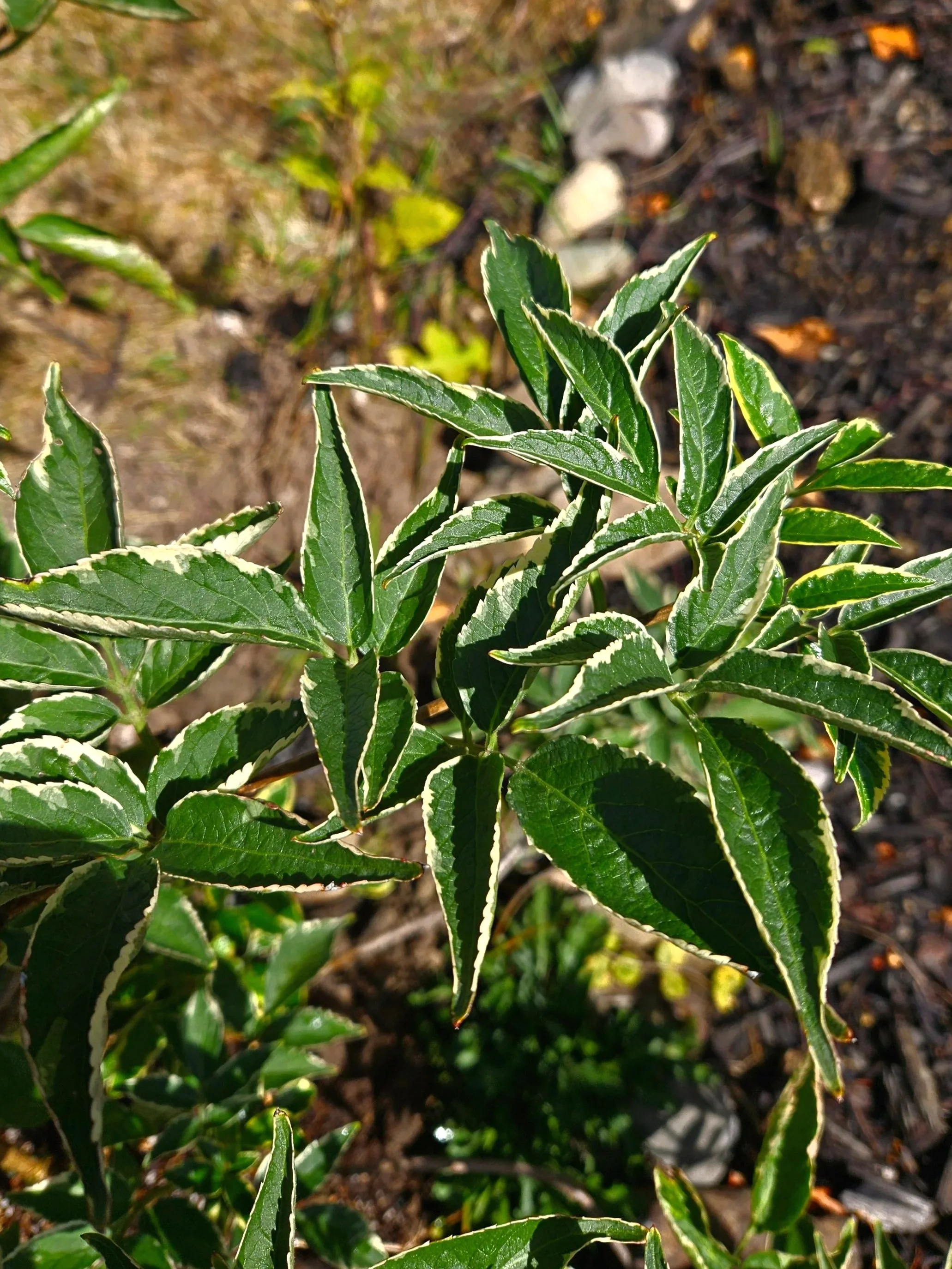
Its foliage is the star of the plant. Each leaf combines green with clean white margins, creating a bright appearance that can visually lift darker areas of a mixed border. Unlike a shrub grown primarily for a brief flowering period, Instant Karma® provides ornamental value throughout much of the growing season.
Large, lacy clusters of white flowers appear from late spring into early summer. When a compatible elderberry such as Black Lace®, Black Beauty®, or Laced Up® is growing nearby for pollination, the flowers can be followed by purple-black berries in autumn.
Reaching approximately 6–8 feet tall and 6–8 feet wide, Instant Karma® can be grown as a substantial shrub, trained toward a small-tree form, used for screening, or incorporated into a large perennial garden.
Why We Grow It at 19 Birch Lane
At 19 Birch Lane, Instant Karma® is especially interesting because its primary ornamental value does not depend entirely on flowers.
The crisp variegated foliage provides color and contrast for months.
That makes it an excellent example of an important principle we use when developing the gardens: foliage can be just as important as flowers.
The green-and-white leaves can brighten surrounding plantings and provide contrast against darker foliage, while the lacy white flowers add another layer of interest in late spring and early summer.
When planted with a suitable pollinating elderberry, the possibility of purple-black fruit adds still another seasonal element and additional value for birds.
This combination of foliage, flowers, fruit, wildlife value, hardiness, and substantial size makes Instant Karma® particularly useful as we continue building more layered and educational plant collections at 19 Birch Lane.
Quick Facts
Botanical Name: Sambucus nigra
Common Name: Instant Karma® Elderberry
Plant Type: Deciduous Shrub
USDA Hardiness Zones: 4–7
Mature Height: 6–8 feet
Mature Spread: 6–8 feet
Recommended Spacing: 6–8 feet
Growth Habit: Upright
Bloom Time: Late Spring to Early Summer
Flower Color: White
Flower Form: Large, Lacy Clusters
Fragrance: Fragrant
Foliage: Green with White Margins
Fruit: Purple-Black Berries When Properly Pollinated
Light: Part Sun to Full Sun
Full Sun: 6+ Hours
Part Sun: Approximately 4–6 Hours
Water Needs: Average
Maintenance: Easy
Blooms On: Old Wood
Attracts: Bees and Birds
Deer Resistant: Yes
Rabbit Resistant: Yes
Drought Tolerant: Yes
Container Role: Thriller
Growing Conditions
Light Requirements
Instant Karma® Elderberry grows in:
Full Sun
Part Sun
Approximately 4–6 Hours of Sun in Part-Sun Locations
6+ Hours of Sun in Full-Sun Locations
Its variegated foliage makes it especially useful where a bright-leaved shrub is needed to provide contrast within a larger planting.
Water Requirements
Instant Karma® has average water requirements.
Newly planted shrubs should receive consistent moisture while establishing their root systems.
Once established, the plant is considered drought tolerant, although prolonged periods of severe dryness can still place unnecessary stress on the shrub.
A practical watering approach is:
Water consistently during establishment.
Monitor during extended dry periods.
Water deeply rather than providing frequent shallow watering.
Avoid allowing newly planted specimens to dry severely.
Flower Characteristics
Large, lacy clusters of white flowers appear from late spring into early summer.
Flower Features
White
Fragrant
Large Clusters
Lacy Appearance
Late Spring to Early Summer Bloom
Attractive to Bees
The delicate flowers provide a beautiful contrast against the variegated foliage.
Foliage Characteristics
The foliage is the defining feature of Instant Karma®.
Foliage Features
Green Centers
Crisp White Margins
Strong Variegation
Bright Appearance
Season-Long Foliage Interest
Variegated plants are particularly valuable for breaking up large areas of solid green foliage.
Instant Karma® can therefore provide the visual effect of a flowering plant even before or after its actual bloom period.
What Is Variegated Foliage?
Variegated foliage contains more than one visible leaf color.
In Instant Karma®, the leaves combine green with white margins.
This creates additional contrast within the landscape and makes the shrub useful for brightening mixed borders.
Variegation Reversion
Like many variegated plants, Instant Karma® may occasionally produce branches that revert to solid green foliage.
If this happens, remove the reverted growth.
Allowing vigorous all-green shoots to remain can eventually reduce the overall variegated appearance of the plant.
Inspect the shrub periodically and prune out solid-green reversions as needed.
Berry Production
Instant Karma® can produce purple-black berries in autumn, but cross-pollination is required for reliable fruit production.
Recommended Pollinators
Plant one of the following nearby:
Black Lace® Elderberry
Black Beauty® Elderberry
Laced Up® Elderberry
Without a compatible pollinating elderberry, Instant Karma® should primarily be considered an ornamental foliage and flowering shrub rather than a dependable berry-producing plant.
Does Instant Karma® Elderberry Need Another Elderberry to Produce Berries?
Yes, if berry production is your goal.
Instant Karma® requires a compatible pollinating elderberry nearby for fruit production.
Suitable choices include:
Black Lace®
Black Beauty®
Laced Up®
This is an important consideration when designing an elderberry collection.
Pollinator & Wildlife Benefits
Instant Karma® contributes to wildlife-friendly landscapes in more than one way.
Attracts
Bees
Birds
The flowers provide value to visiting bees, while berries produced following successful pollination can add wildlife interest later in the season.
Its combination of flowers and fruit makes elderberry an interesting plant for demonstrating the connection between pollination and fruit production.
Deer & Rabbit Resistance
Instant Karma® is listed as resistant to:
Deer
Rabbits
No plant is completely browse-proof, particularly where animal pressure is high, but resistance can make Instant Karma® useful in landscapes where deer and rabbits are common concerns.
Drought Tolerance
Instant Karma® is considered drought tolerant once established.
That does not mean newly planted shrubs should be allowed to dry out.
Regular watering during establishment helps create a stronger root system capable of handling future dry periods.
Garden Uses
At 6–8 feet tall and equally wide, Instant Karma® is large enough to provide meaningful structure within the landscape.
Recommended Uses
Mixed Shrub Borders
Perennial Borders
Screening
Mass Plantings
Specimen Plantings
Focal Points
Wildlife Gardens
Pollinator Gardens
Foliage Gardens
Variegated Plant Collections
Cottage Gardens
Large Landscapes
Botanical Collections
It can also be grown as a large shrub or developed toward a small-tree form.
Using Instant Karma® as a Screening Plant
The shrub's 6–8 foot mature height and spread make it useful for informal screening.
It can help:
Define garden rooms
Soften boundaries
Screen less attractive views
Add height behind perennial beds
Create a leafy backdrop
For screening, allow enough room for the plant to achieve its natural width rather than crowding plants together excessively.
Using Instant Karma® in a Perennial Garden
One of the more interesting ways to use Instant Karma® is within a large perennial garden.
If grown primarily for foliage, it can be cut back more aggressively in early spring.
The resulting new growth creates a substantial spray of bright variegated foliage that can function almost like an oversized perennial.
This approach prioritizes foliage rather than flowers and berries.
Companion Plants
Instant Karma® works especially well with plants that emphasize its white variegation.
Recommended Companion Plants for 19 Birch Lane
Black Lace® Elderberry
Dark-Foliaged Ninebark
Hydrangeas
Catmint
Salvia
Coneflower
Bee Balm
Sedum ‘Autumn Joy’
Japanese Anemone
Hostas
Ornamental Grasses
Dark-Foliaged Heuchera
Rhododendrons
Dark foliage is particularly effective because it makes the white leaf margins stand out.
Whenever corresponding 19 Birch Lane Plant Finder listings exist, companion plant names should link directly to those pages.
Care & Maintenance
Instant Karma® is considered an easy-care shrub.
It can be left largely unpruned or managed more actively depending on the desired garden effect.
Pruning Instant Karma® Elderberry
The correct pruning time depends on what you want from the plant.
For Flowers and Berries
Instant Karma® blooms on old wood.
If flowering and fruiting are priorities, prune after flowering rather than cutting the shrub heavily in early spring.
This preserves the older wood responsible for the flower display.
For Foliage
If you are growing Instant Karma® primarily for its variegated leaves, it can be pruned in early spring.
Cutting it back encourages vigorous new foliage.
The tradeoff is important:
Heavy early-spring pruning may reduce that season's flowers and therefore reduce potential berry production.
Removing Reverted Growth
Check periodically for stems producing entirely green leaves.
If found:
Trace the reverted branch back to its origin.
Remove the entire reverted shoot.
Continue monitoring throughout the growing season.
This helps preserve the crisp variegated appearance.
Cold-Climate Performance in Maine
Instant Karma® is rated for USDA Zones 4–7, making its hardiness range particularly appropriate for many northern gardens.
For a Zone 6 garden in Midcoast Maine, it sits comfortably within its stated hardiness range.
That makes Instant Karma® particularly interesting for gardeners looking for a dramatic variegated shrub that can withstand cold winters.
The plant is not recommended for hot climates in Zone 8 and warmer, making its northern adaptability an especially important feature.
Landscape Design Ideas
Instant Karma® works beautifully where its foliage can contrast against darker plants.
Try combinations such as:
Instant Karma® + Black Lace® Elderberry + Catmint
The nearly black foliage of Black Lace® emphasizes Instant Karma's white variegation while also providing the compatible elderberry needed for berry production.
Another strong combination is:
Instant Karma® + dark Ninebark + white Hydrangea + ornamental grasses
This creates multiple layers of:
Dark foliage
Variegated foliage
White flowers
Fine grass texture
For a brighter perennial border, combine it with:
Purple Salvia
Blue Catmint
Pink Coneflowers
White Hydrangeas
Burgundy Heuchera
Why Gardeners Love Instant Karma® Elderberry
✔ Crisp green-and-white variegated foliage
✔ Large lacy white flowers
✔ Fragrant flowers
✔ Purple-black fruit when properly pollinated
✔ Hardy in Zones 4–7
✔ Excellent foliage interest
✔ Attracts bees
✔ Attracts birds
✔ Deer resistant
✔ Rabbit resistant
✔ Drought tolerant once established
✔ Easy care
✔ Useful for screening
✔ Works as a specimen
✔ Can be grown as a large shrub or small tree
✔ Can be managed primarily as a foliage plant
Plant Finder Details
Botanical Name: Sambucus nigra
Common Name: Instant Karma® Elderberry
Plant Type: Deciduous Shrub
USDA Hardiness Zones: 4a–7b
Mature Height: 72–96 inches / 6–8 feet
Mature Spread: 72–96 inches / 6–8 feet
Recommended Spacing: 72–96 inches / 6–8 feet
Growth Habit: Upright
Flower Color: White
Flower Fragrance: Fragrant
Bloom Time: Late Spring to Early Summer
Blooms On: Old Wood
Foliage: Green with White Margins
Foliage Interest: Excellent
Fruit: Purple-Black Berries with Compatible Pollinator
Light: Part Sun to Full Sun
Water: Average
Maintenance: Easy
Attracts Bees: Yes
Attracts Birds: Yes
Deer Resistant: Yes
Rabbit Resistant: Yes
Drought Tolerant: Yes
Screening Plant: Yes
Mass Planting: Yes
Specimen/Focal Point: Yes
Container Role: Thriller
Heat Limitation: Not Recommended for Zone 8 and Warmer
📍 Where to Find Instant Karma® Elderberry at 19 Birch Lane
Instant Karma® is particularly well suited to a mixed shrub or perennial planting where its variegated foliage can be viewed against darker surrounding plants.
It would also work especially well near another compatible elderberry if fruit production is desired.
The exact permanent location of Instant Karma® Elderberry at 19 Birch Lane has not yet been provided for this Plant Finder entry.
Once its location is confirmed, this section should be updated with the specific garden name so visitors can use the Plant Finder to locate the living specimen.
🌸 Seasonal Interest Calendar
🌱 Spring
New green-and-white variegated foliage emerges and quickly becomes one of the shrub's primary ornamental features.
If growing primarily for foliage, early spring is the appropriate time for more substantial pruning.
🤍 Late Spring
Large lacy flower clusters begin developing against the variegated leaves.
Bees may visit the flowers.
🌼 Early Summer
White fragrant flowers create the primary floral display.
If flowers and fruit are priorities, wait until flowering has finished before performing significant pruning.
🌿 Summer
The variegated foliage continues providing strong color and contrast after flowering.
Monitor for any solid-green reverted shoots and remove them.
🫐 Fall
When successfully cross-pollinated by a compatible elderberry, purple-black fruit can provide another season of interest.
Bird activity may increase around fruiting plants.
❄️ Winter
The deciduous shrub loses its foliage and enters dormancy before beginning its seasonal cycle again in spring.
🎓 Garden Design Tips from 19 Birch Lane
At 19 Birch Lane, we would design around Instant Karma® primarily as a foliage contrast plant.
The white margins become much more dramatic when the shrub is positioned against dark green or burgundy foliage.
One of the strongest combinations would be:
Instant Karma® Elderberry + Black Lace® Elderberry.
This pairing accomplishes two things at once.
Visually, the dark foliage of Black Lace® creates an excellent background for Instant Karma's bright variegation.
Functionally, Black Lace® can also provide the compatible pollination needed for Instant Karma® to produce berries.
That is the type of planting relationship we want the Plant Finder to help visitors understand: why plants work together, not simply which plants look good together.
For a larger composition, consider:
Instant Karma® + Black Lace® Elderberry + Hydrangea + Catmint + ornamental grasses.
The combination provides substantial differences in foliage color, texture, flower form, height, and seasonal interest.
🌿 Plants That Grow Well with Instant Karma® Elderberry at 19 Birch Lane
Recommended companions include:
Black Beauty® Elderberry
Ninebark
Bee Balm
Sedum ‘Autumn Joy’
Heuchera
Ornamental Grasses
For berry production, prioritize a compatible elderberry such as Black Lace®, Black Beauty®, or Laced Up®.
As corresponding Plant Finder profiles become available, link these plants directly to their individual pages.
Frequently Asked Questions
What is Instant Karma® Elderberry?
Instant Karma® is a deciduous elderberry shrub grown primarily for its crisp green-and-white variegated foliage, fragrant white flowers, and potential purple-black berries.
What is the botanical name of Instant Karma® Elderberry?
Its botanical name is Sambucus nigra.
How big does Instant Karma® Elderberry get?
It typically reaches approximately 6–8 feet tall and 6–8 feet wide.
Is Instant Karma® Elderberry hardy in Maine?
Instant Karma® is rated for USDA Zones 4–7, making it suitable for many cold-climate gardens within that range, including Zone 6 conditions.
How much sun does Instant Karma® Elderberry need?
It grows in part sun to full sun. Part sun represents approximately 4–6 hours of sunlight, while full sun is 6 or more hours.
When does Instant Karma® Elderberry bloom?
It blooms from late spring into early summer.
What color are the flowers?
Instant Karma® produces large clusters of white flowers.
Are Instant Karma® Elderberry flowers fragrant?
Yes. The flowers are fragrant.
Does Instant Karma® produce berries?
It can produce purple-black berries when a compatible elderberry is planted nearby for cross-pollination.
Does Instant Karma® need another elderberry to produce fruit?
Yes. A compatible pollinator is needed for berry production.
What pollinates Instant Karma® Elderberry?
Recommended pollinating varieties include Black Lace®, Black Beauty®, and Laced Up® elderberries.
Does Instant Karma® Elderberry attract birds?
Yes. The plant is listed as attracting birds, particularly when fruit is produced.
Does Instant Karma® attract bees?
Yes. Bees visit the flowers.
Is Instant Karma® deer resistant?
Yes. It is listed as deer resistant.
Is Instant Karma® rabbit resistant?
Yes. It is also listed as rabbit resistant.
Is Instant Karma® drought tolerant?
Yes, it is considered drought tolerant once established.
When should Instant Karma® Elderberry be pruned?
If flowers and berries are important, prune after flowering because the plant blooms on old wood. If growing primarily for foliage, it can be pruned in early spring.
Why is my Instant Karma® Elderberry producing solid green leaves?
Variegated plants can occasionally revert to their original green form. Remove solid-green shoots to help maintain the plant's variegated appearance.
Can Instant Karma® Elderberry be used for screening?
Yes. Its mature size of approximately 6–8 feet tall and wide makes it suitable for informal screening.
Can Instant Karma® be grown like a small tree?
Yes. It can be grown as a large shrub or managed toward a small-tree form.
Botanical Garden Notes
Instant Karma® is particularly useful as an educational plant because it demonstrates several important horticultural concepts within one shrub.
First is variegation. Its green-and-white foliage shows how leaf color can become a major component of garden design.
Second is reversion. Occasional all-green shoots demonstrate how variegated plants can revert and why selective pruning is important.
Third is old-wood flowering. The timing of pruning directly affects flowering because Instant Karma® produces flowers on older stems.
Finally, its fruiting illustrates the importance of cross-pollination. A beautiful flowering shrub does not necessarily produce a crop of berries unless a compatible pollinator is growing nearby.
Those characteristics make Instant Karma® more than an ornamental shrub—it can become a useful teaching plant within the developing botanical collections at 19 Birch Lane.