
Ruby Slippers Oakleaf HydrangeaHydrangea quercifolia ‘Ruby Slippers’
A compact North American oakleaf hydrangea with dramatic white-to-ruby-red flowers, deeply lobed foliage, brilliant autumn color, and attractive winter bark.
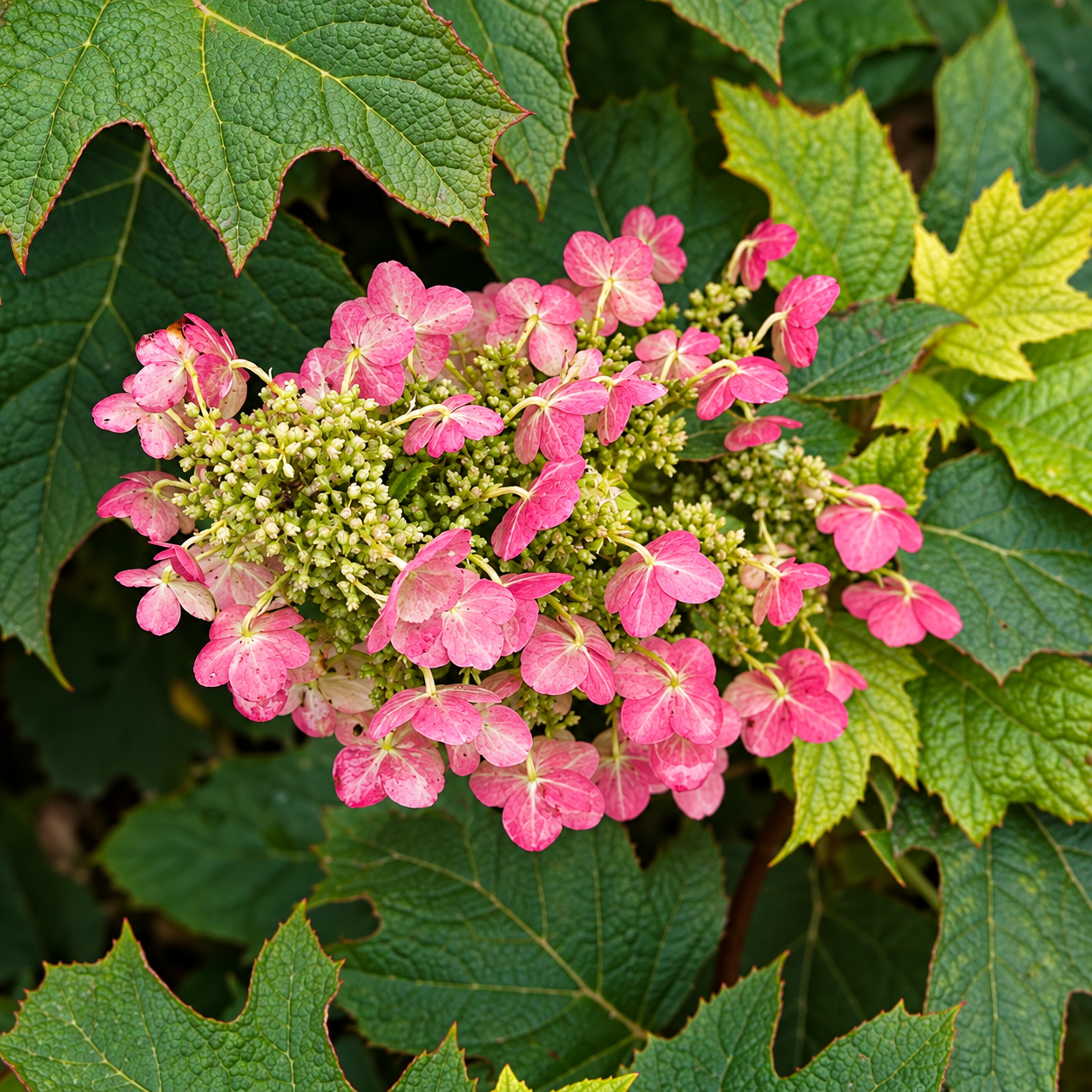
Ruby Slippers Oakleaf HydrangeaHydrangea quercifolia ‘Ruby Slippers’
A compact North American oakleaf hydrangea with dramatic white-to-ruby-red flowers, deeply lobed foliage, brilliant autumn color, and attractive winter bark.
Plant Overview
Common Name: Ruby Slippers Oakleaf Hydrangea
Botanical Name: Hydrangea quercifolia ‘Ruby Slippers’
Family: Hydrangeaceae — Hydrangea Family
Plant Type: Deciduous Flowering Shrub
USDA Hardiness Zones: 5–9
Primary Seasons of Interest: Summer, Fall, and Winter
Ruby Slippers Oakleaf Hydrangea is an exceptional compact flowering shrub known for its large upright flower clusters, dramatic seasonal color changes, and distinctive oak-shaped foliage.
Unlike traditional bigleaf hydrangeas, which are often grown primarily for their rounded blue or pink flowers, Ruby Slippers provides interest throughout much of the year.
Its flowers emerge creamy white in early summer, gradually develop soft pink tones, and eventually mature to a deep rose or ruby-red color. This transformation gives the shrub an extended ornamental season without relying on repeat flowering.
The foliage is equally impressive. Large, deeply lobed leaves create a bold texture throughout summer before developing rich shades of burgundy, mahogany, and red in autumn.
As the leaves fall, mature stems reveal exfoliating bark with warm cinnamon-brown tones.
The result is a shrub that contributes flowers, foliage, structure, and winter texture.
Ruby Slippers was developed by the U.S. National Arboretum and introduced in 2010 as a compact selection suitable for smaller landscapes.
For gardeners in Maine, its combination of manageable size, showy flowers, and autumn interest makes it particularly appealing in protected Zone 5 and Zone 6 locations.
Why Ruby Slippers Belongs in the 19 Birch Lane Plant Finder
At 19 Birch Lane, one of our central garden design principles is creating landscapes that remain interesting beyond a single flowering period.
A successful garden should offer something to appreciate in spring, summer, autumn, and even winter.
Ruby Slippers is an excellent example of a shrub that contributes to this goal.
Its flowers provide summer color, its large leaves create texture throughout the growing season, and its autumn foliage brings rich red and burgundy tones to the landscape.
Even after leaf drop,ts branching structure and exfoliating bark remain visually interesting.
As we continue developing the botanical gardens at 19 Birch Lane, plants like Ruby Slippers help illustrate the importance of selecting shrubs for multiple ornamental characteristics.
This hydrangea also provides valuable educational opportunities.
Visitors and home gardeners can learn about:
Oakleaf versus bigleaf hydrangeas
Native North American flowering shrubs
Compact shrub breeding
Flower color changes during maturation
Old-wood flowering
Fall foliage development
Exfoliating bark
Winter garden structure
Hydrangea pruning
Creating multi-season landscapes
Ruby Slippers demonstrates that an outstanding garden shrub does not need to be in flower to contribute beauty.
Quick Facts
Common Name: Ruby Slippers Oakleaf Hydrangea
Botanical Name: Hydrangea quercifolia ‘Ruby Slippers’
Family: Hydrangeaceae
Plant Type: Deciduous Flowering Shrub
Species Native Range: Southeastern United States
Cultivar Origin: U.S. National Arboretum
Introduced: 2010
USDA Hardiness Zones: 5–9
Mature Height: Approximately 3–4 Feet
Mature Spread: Approximately 3–5 Feet
Growth Habit: Compact, Rounded, Multi-Stemmed
Growth Rate: Moderate
Flower Color: White, Aging to Pink and Deep Rose-Red
Flower Shape: Upright, Cone-Shaped Panicles
Flower Length: Up to Approximately 9 Inches
Bloom Time: Early to Midsummer
Foliage: Deeply Lobed, Oak-Shaped, Green
Fall Foliage: Burgundy, Mahogany, and Red
Winter Interest: Exfoliating Bark
Sun Exposure: Full Sun to Partial Shade
Water Requirements: Moderate
Soil: Organic-Rich, Well-Drained
Blooms On: Old Wood
Maintenance: Low to Moderate
Pollinator Value: Some Benefit Where Fertile Flowers Are Present
Deer Resistance: Not Reliably Deer Resistant
Cut Flowers: Yes
Dried Flowers: Yes
Garden Uses: Borders, Specimens, Foundations, Woodland Edges, Informal Hedges
Growing Conditions
Light Requirements
Ruby Slippers grows best in full sun to partial shade.
For many northern gardens, a location receiving morning sunlight and some afternoon shade provides a good balance between flowering and protection from summer heat.
Ideal conditions include:
Morning Sun
Filtered Afternoon Shade
Bright Woodland Edges
Sheltered Mixed Shrub Borders
Locations with Good Air Circulation
Adequate sunlight encourages strong flowering and can contribute to attractive fall foliage.
However, excessive sun combined with dry soil can stress the plant.
In Midcoast Maine, a sheltered location receiving several hours of direct sunlight is an excellent starting point.
Soil Requirements
Ruby Slippers prefers:
Organic-Rich Soil
Good Drainage
Moderate Soil Moisture
Loamy Garden Soil
Minimal Compaction
Unlike bigleaf hydrangeas, Ruby Slippers does not require acidic soil to produce its characteristic flower color.
Its white-to-red flower progression is primarily a feature of the cultivar's natural flower maturation rather than a response to soil pH.
This distinction is important when comparing different hydrangea groups.
Water Requirements
Ruby Slippers prefers consistent moisture, particularly during establishment.
Newly planted shrubs should be watered deeply and regularly until their root systems become established.
Once established, oakleaf hydrangeas can tolerate moderate dry periods better than some other commonly grown hydrangeas.
However, prolonged drought can reduce growth, cause leaf stress, and affect flowering.
Recommended watering practices:
Water deeply during establishment.
Monitor moisture during extended dry periods.
Apply organic mulch.
Avoid prolonged waterlogging.
Reduce unnecessary overhead watering.
Flower Characteristics
Ruby Slippers produces upright, elongated flower clusters known as panicles.
The flower heads can reach approximately 9 inches long under favorable conditions.
Flower Color Progression
Early Summer — Creamy White
Flowers open in creamy white clusters above the foliage.
Midsummer — Soft Pink
As the flowers mature, they gradually develop pale pink coloration.
Late Summer — Deep Rose to Ruby Red
The flowers deepen to rich rose-red tones, creating the characteristic appearance that inspired the cultivar's name.
This progression can produce a mixture of white, pink, and red flowers on the same shrub.
The intensity and timing of color development may vary with weather, sunlight, and plant maturity.
Does Soil pH Change Ruby Slippers Flower Color?
No, not in the way soil pH influences blue and pink bigleaf hydrangeas.
Ruby Slippers naturally changes from white to pink and deep rose-red as its flowers age.
Adding aluminum sulfate or altering soil acidity is not necessary to produce its characteristic red flowers.
Foliage Characteristics
The foliage is one of the most recognizable features of oakleaf hydrangeas.
Ruby Slippers produces large, deeply lobed leaves that resemble those of an oak tree.
Summer Foliage
Deep Green
Broad
Distinctively Lobed
Bold in Texture
Attractive in Mixed Shrub Plantings
The leaves provide a strong visual contrast with finer-textured perennials, ferns, and ornamental grasses.
Autumn Foliage
As temperatures cool, the foliage can develop spectacular shades of:
Burgundy
Mahogany
Deep Red
Reddish Purple
The fall display can be one of the shrub's strongest ornamental features.
Color intensity varies with growing conditions and seasonal weather.
Winter Interest: Exfoliating Bark
One of the most overlooked features of oakleaf hydrangeas is their bark.
As Ruby Slippers matures, older branches may develop peeling, exfoliating bark that reveals warm brown and cinnamon-colored layers.
This creates texture and visual interest after the leaves have fallen.
In a winter garden, the bark can be particularly attractive when viewed against snow, evergreen foliage, or natural stone.
The effect becomes more pronounced as the shrub ages.
Cold Hardiness in Maine
Ruby Slippers is generally rated for USDA Zones 5–9.
That includes many Zone 6 gardens in Midcoast Maine.
However, gardeners should distinguish between a shrub's ability to survive winter and its ability to flower reliably.
Ruby Slippers blooms on old wood.
Its flower buds develop on stems produced during the previous growing season.
If those buds are damaged by winter cold, the plant may produce healthy foliage the following spring but fewer flowers.
Recommended Maine Growing Practices
Plant in a sheltered location.
Avoid exposed winter winds.
Maintain adequate soil moisture before the ground freezes.
Apply organic mulch around the root zone.
Avoid heavy fall pruning.
Protect young plants during severe winters when practical.
Preserve healthy overwintered stems.
In colder Zone 5 locations, additional protection may improve flowering reliability.
Coastal Maine Considerations
Coastal Maine can experience fluctuating winter temperatures, strong winds, and repeated freezing and thawing.
A protected woodland edge or sheltered garden border may provide more favorable conditions than an exposed planting near an open field.
Choosing the right location is particularly important for young plants.
Blooms on Old Wood
Ruby Slippers flowers on growth produced during the previous growing season.
This is one of the most important details for gardeners to understand.
What Does Old-Wood Flowering Mean?
The shrub develops flower buds before winter.
Those buds remain on the plant through the dormant season and open during the following summer.
Heavy pruning in fall or early spring can remove the flower buds.
When Should Ruby Slippers Be Pruned?
If pruning is necessary, prune immediately after flowering.
In most cases, Ruby Slippers requires little pruning beyond removing damaged or poorly positioned branches.
Pollinator & Wildlife Benefits
Oakleaf hydrangea is a North American native species, and its flowers can contribute resources for visiting insects.
Ruby Slippers has showy flower clusters containing many ornamental florets.
Where fertile flowers are present and accessible, they may provide resources for pollinating insects.
However, heavily ornamental flower clusters should not automatically be assumed to offer the same pollinator value as the straight species or a locally native wildflower.
For a stronger pollinator planting, combine Ruby Slippers with a diversity of native flowering plants that bloom at different times.
Deer and Rabbit Resistance
Ruby Slippers is not reliably deer resistant.
Deer may browse:
Young Leaves
Tender Stems
Flower Buds
New Growth
Browsing pressure varies by location and season.
Young shrubs may require protection in areas with heavy deer activity.
Garden Uses
Ruby Slippers is especially effective in:
Mixed Shrub Borders
Foundation Plantings
Woodland Edges
Cottage Gardens
Native-Species Cultivar Collections
Hydrangea Collections
Summer Flower Gardens
Autumn Color Gardens
Garden Entrances
Informal Hedges
Specimen Plantings
Mass Plantings
Patio Borders
Four-Season Gardens
Botanical Collections
Its compact growth makes it easier to incorporate into smaller spaces than larger oakleaf hydrangea selections.
Using Ruby Slippers in a Mixed Shrub Border
Ruby Slippers can serve as a focal point within a mixed planting.
Its upright flower clusters contrast with rounded flowering shrubs and spreading perennials.
For a balanced composition, combine it with plants that provide different textures and flowering periods.
Consider:
Ruby Slippers + Catmint + Coneflower + Autumn Joy Sedum
This combination can provide:
Summer Hydrangea Flowers
Fine-Textured Catmint
Daisy-Like Coneflowers
Late-Season Sedum Flowers
Attractive Autumn Foliage
Choose the placement carefully so each plant receives appropriate sunlight and moisture.
Using Ruby Slippers in a Woodland-Edge Garden
Ruby Slippers can be particularly attractive near the edge of a woodland garden.
Its large leaves and summer flowers contrast beautifully with:
Ferns
Hostas
Hellebores
Brunnera
Japanese Forest Grass
Rhododendrons
Japanese Maples
The shrub benefits from bright light while neighboring shade-tolerant perennials can occupy slightly more sheltered areas.
This type of layered planting can create a natural transition between open gardens and wooded landscapes.
Companion Plants
Recommended companions include:
Autumn Joy Sedum (Hylotelephium)
Ferns
Hellebores
Brunnera
Astilbe
Japanese Maples
Ornamental Grasses
Asters
Black-Eyed Susan (Rudbeckia)
Choose companions based on the specific sunlight and soil moisture conditions of the planting location.
Care & Maintenance
Ruby Slippers is relatively low maintenance when planted in a suitable location.
Important maintenance practices include:
Watering During Establishment
Maintaining Well-Drained Soil
Applying Organic Mulch
Preserving Overwintered Flower Buds
Avoiding Unnecessary Pruning
Removing Dead or Damaged Branches
Monitoring for Common Pests and Diseases
Protecting Young Plants from Deer Browsing
Pruning Ruby Slippers Oakleaf Hydrangea
When Should Ruby Slippers Be Pruned?
Prune shortly after flowering if shaping is necessary.
How to Prune
Remove dead branches.
Remove damaged stems.
Thin crossing branches.
Preserve healthy older stems.
Maintain the shrub's natural rounded shape.
Avoid annual heavy cutting.
Because Ruby Slippers is naturally compact, extensive pruning is usually unnecessary.
Important Maine Pruning Advice
Wait until spring growth begins before deciding whether a winter-exposed branch is dead.
A stem that appears lifeless in early spring may still contain viable buds.
Avoid removing healthy wood unnecessarily.
Mulching
Apply approximately 2–3 inches of organic mulch around the root zone.
Suitable materials include:
Shredded Bark
Composted Leaves
Pine Needles
Fine Wood Mulch
Mulch helps conserve moisture, moderate soil temperatures, and reduce weed competition.
Keep mulch away from direct contact with the stems.
Fertilizing
Ruby Slippers generally does not require heavy fertilization.
Where soil fertility is adequate, compost or a modest spring application of balanced fertilizer may be sufficient.
Avoid excessive nitrogen, which can encourage foliage growth without improving flowering.
A soil test is the best starting point when nutrient deficiencies are suspected.
Potential Problems
Ruby Slippers may occasionally experience:
Powdery Mildew
Leaf Spot
Aphids
Spider Mites
Winter Bud Damage
Drought Stress
Root Problems in Poorly Drained Soil
Deer Browsing
Good air circulation, appropriate watering, and careful placement help reduce many of these problems.
Plant Safety
Oakleaf hydrangeas contain compounds that can be harmful if ingested.
Keep leaves, flowers, and other plant material away from children and pets who may chew or consume them.
Landscape Design Ideas
Summer-to-Fall Color Garden
Ruby Slippers + Coneflower + Autumn Joy Sedum + Asters
This combination extends seasonal interest from summer into fall.
Woodland-Edge Planting
Ruby Slippers + Hosta + Ferns + Hellebores
The hydrangea provides summer flowers and autumn foliage, while the companion plants contribute contrasting textures.
Cottage Garden Border
Ruby Slippers + Catmint + Daylilies + Hardy Geranium
The combination creates a layered planting with contrasting flower forms and foliage.
Four-Season Shrub Garden
Ruby Slippers + Evergreen Rhododendrons + Ornamental Grasses
Evergreens provide winter structure, while the hydrangea contributes flowers, autumn color, and exfoliating bark.
Why Gardeners Love Ruby Slippers Oakleaf Hydrangea
✓ Flowers Change from White to Ruby Red
✓ Compact Growth Habit
✓ Large Upright Flower Clusters
✓ Beautiful Oak-Shaped Leaves
✓ Outstanding Autumn Color
✓ Attractive Exfoliating Bark
✓ North American Native-Species Cultivar
✓ Suitable for Smaller Gardens
✓ Good for Mixed Shrub Borders
✓ Excellent Woodland-Edge Shrub
✓ Low to Moderate Maintenance
✓ Valuable for Four-Season Garden Design
✓ Hardy in Many Maine Gardens
✓ Excellent Educational Plant
✓ Useful in Hydrangea Collections
Plant Finder Details
Common Name: Ruby Slippers Oakleaf Hydrangea
Botanical Name: Hydrangea quercifolia ‘Ruby Slippers’
Family: Hydrangeaceae
Plant Type: Deciduous Flowering Shrub
Species Native Range: Southeastern United States
Cultivar Origin: U.S. National Arboretum
Introduction Year: 2010
USDA Zones: 5–9
Height: 3–4 Feet
Spread: 3–5 Feet
Growth Habit: Compact, Rounded
Growth Rate: Moderate
Exposure: Full Sun to Partial Shade
Soil: Organic-Rich, Well-Drained
Water: Moderate
Bloom Season: Early to Midsummer
Flower Color: White, Pink, Deep Rose-Red
Flower Form: Upright Panicles
Flower Length: Up to Approximately 9 Inches
Foliage: Deeply Lobed, Green
Fall Color: Burgundy, Mahogany, Red
Winter Interest: Exfoliating Bark
Blooms On: Old Wood
Pollinator Value: Variable; Fertile Flowers May Attract Insects
Deer Resistance: Not Reliable
Cut Flowers: Yes
Dried Flowers: Yes
Maintenance: Low to Moderate
Maine Garden Suitability: Good in Sheltered Zone 5–6 Locations
📍 Where to Find Ruby Slippers Oakleaf Hydrangea at 19 Birch Lane
Ruby Slippers is particularly well suited to mixed shrub borders, woodland edges, and garden areas designed for strong summer and autumn interest.
Its changing flowers and colorful fall foliage make it an excellent shrub to position where visitors can observe seasonal transitions.
You may find the Ruby Slipper oak leaf hydrangea in the outer edge of the main garden and 19 Birch Lane.
🌸 Seasonal Interest Calendar
🌱 Spring
New green leaves emerge with their distinctive oak-like shape.
Inspect the shrub for winter damage, but avoid unnecessary pruning.
🤍 Early Summer
Creamy white flower panicles begin opening above the foliage.
🌸 Midsummer
Flowers transition from white to pink.
❤️ Late Summer
The flower clusters deepen to rose and ruby-red tones.
🍂 Fall
The foliage develops rich shades of burgundy, mahogany, and red.
❄️ Winter
After leaf drop, older stems reveal attractive exfoliating bark.
🎓 Garden Design Tips from 19 Birch Lane
One of the most effective ways to create a garden with lasting interest is to choose shrubs that contribute more than flowers.
Ruby Slippers provides an excellent example.
Its flowers are beautiful, but the plant also contributes bold foliage, dramatic autumn color, and winter bark texture.
For a strong seasonal combination, consider:
Ruby Slippers + Catmint + Coneflower + Autumn Joy Sedum
The hydrangea provides structure and changing flower color.
Catmint softens the planting with fine-textured foliage and blue-purple flowers.
Coneflowers introduce rounded flower heads, while Autumn Joy Sedum extends interest into late summer and fall.
Another important design principle is allowing enough room for shrubs to mature naturally.
Ruby Slippers may be compact compared with larger oakleaf hydrangeas, but it still requires several feet of growing space.
Planting with its mature spread in mind helps preserve the natural form and reduces future pruning.
At 19 Birch Lane, this kind of long-term planning is an important part of developing gardens that become more beautiful as they mature.
🌿 Plants That Grow Well with Ruby Slippers at 19 Birch Lane
Recommended companions and related Plant Finder profiles include:
Catmint
Coneflower
Autumn Joy Sedum
Daylilies
Hostas
Ferns
Hellebores
Brunnera
Japanese Maples
Rhododendrons
Asters
Ornamental Grasses
Where individual Plant Finder entries already exist, link the plant names directly to their corresponding pages.
Frequently Asked Questions
What is Ruby Slippers Oakleaf Hydrangea?
Ruby Slippers is a compact cultivar of oakleaf hydrangea known for upright flower clusters that change from white to deep rose-red, oak-shaped foliage, and attractive autumn color.
What is the botanical name of Ruby Slippers?
The botanical name is Hydrangea quercifolia ‘Ruby Slippers’.
How large does Ruby Slippers grow?
It generally grows approximately 3–4 feet tall and 3–5 feet wide.
Is Ruby Slippers a dwarf hydrangea?
It is a compact or semi-dwarf oakleaf hydrangea, considerably smaller than many traditional oakleaf hydrangea selections.
When does Ruby Slippers bloom?
It typically flowers in early to midsummer, with bloom timing varying by climate.
What color are Ruby Slippers flowers?
The flowers open white, gradually become pink, and mature to deep rose or ruby red.
Does soil pH change Ruby Slippers flower color?
No. Its white-to-red color progression occurs naturally as the flowers mature and does not depend on soil pH in the same way as blue and pink bigleaf hydrangeas.
Does Ruby Slippers bloom on old wood?
Yes. It flowers on stems produced during the previous growing season.
When should Ruby Slippers be pruned?
Prune immediately after flowering if necessary.
Can Ruby Slippers grow in Maine?
Yes. Its published hardiness range includes Zones 5 and 6, although winter protection and sheltered placement may improve flowering reliability.
Is Ruby Slippers hardy in Zone 6?
Yes. Zone 6 is within its recommended hardiness range.
Does Ruby Slippers prefer sun or shade?
It grows in full sun to partial shade. In many gardens, morning sun and afternoon shade provide a good balance.
Is Ruby Slippers drought tolerant?
Established oakleaf hydrangeas have some drought tolerance, but consistent moisture supports healthy growth and flowering.
Does Ruby Slippers attract pollinators?
Its flowers may attract pollinating insects where fertile flowers are present and accessible.
Is Ruby Slippers deer resistant?
No. Deer may browse leaves, stems, and flower buds.
Does Ruby Slippers have fall color?
Yes. Its oak-shaped leaves can develop beautiful burgundy, mahogany, and red tones in autumn.
Does Ruby Slippers have winter interest?
Yes. Mature stems can develop peeling bark that adds texture to the winter landscape.
Can Ruby Slippers grow in containers?
Yes, in sufficiently large containers with good drainage, although container-grown plants need additional winter protection in Maine.
What plants grow well with Ruby Slippers?
Catmint, coneflowers, sedum, hostas, ferns, daylilies, and ornamental grasses are useful companions when site conditions are compatible.
Botanical Garden Notes
Ruby Slippers Oakleaf Hydrangea was developed through the U.S. National Arboretum's breeding program.
The breeding effort focused on creating compact oakleaf hydrangeas with attractive flowers and growth habits suitable for smaller landscapes.
Ruby Slippers was introduced in 2010.
It originated from a cross between two oakleaf hydrangea cultivars:
‘Snow Queen’
‘Pee Wee’
The resulting selection combined a compact growth habit with large upright flower clusters and distinctive red flower coloration as the blooms matured.
Oakleaf hydrangea is native to the southeastern United States, where it naturally grows in wooded environments, ravines, and along stream banks.
The species name quercifolia refers to its oak-like leaves.
The genus name Hydrangea is derived from Greek words associated with water and vessels, traditionally interpreted as referring to the shape of the plant's seed capsules.
Ruby Slippers provides valuable educational opportunities for discussing:
Native Plant Species and Cultivars
Ornamental Plant Breeding
Flower Color Development
Hydrangea Flower Structure
Old-Wood Flowering
Fall Foliage Pigments
Exfoliating Bark
Compact Shrub Selection
Cold-Climate Gardening
Multi-Season Landscape Design
For the 19 Birch Lane Plant Finder, Ruby Slippers represents an excellent example of how thoughtful plant selection can provide beauty across multiple seasons while helping gardeners understand the relationship between horticulture, ecology, and landscape design.