
Straight Up Red Texas Yucca (Hesperaloe parviflora ‘Straight Up Red’)
A Long-Blooming, Waterwise Perennial with Upright Red-Pink Flowers and Architectural Evergreen Foliage
Plant Overview
Common Name: Straight Up Red Texas Yucca
Botanical Name:Hesperaloe parviflora ‘Straight Up Red’ PPAF
Plant Type: Evergreen Succulent-Like Perennial
Family: Asparagaceae
Hardiness Zones: USDA Zones 5–9
Native Heritage: Cultivar of a species native to Texas and northeastern Mexico
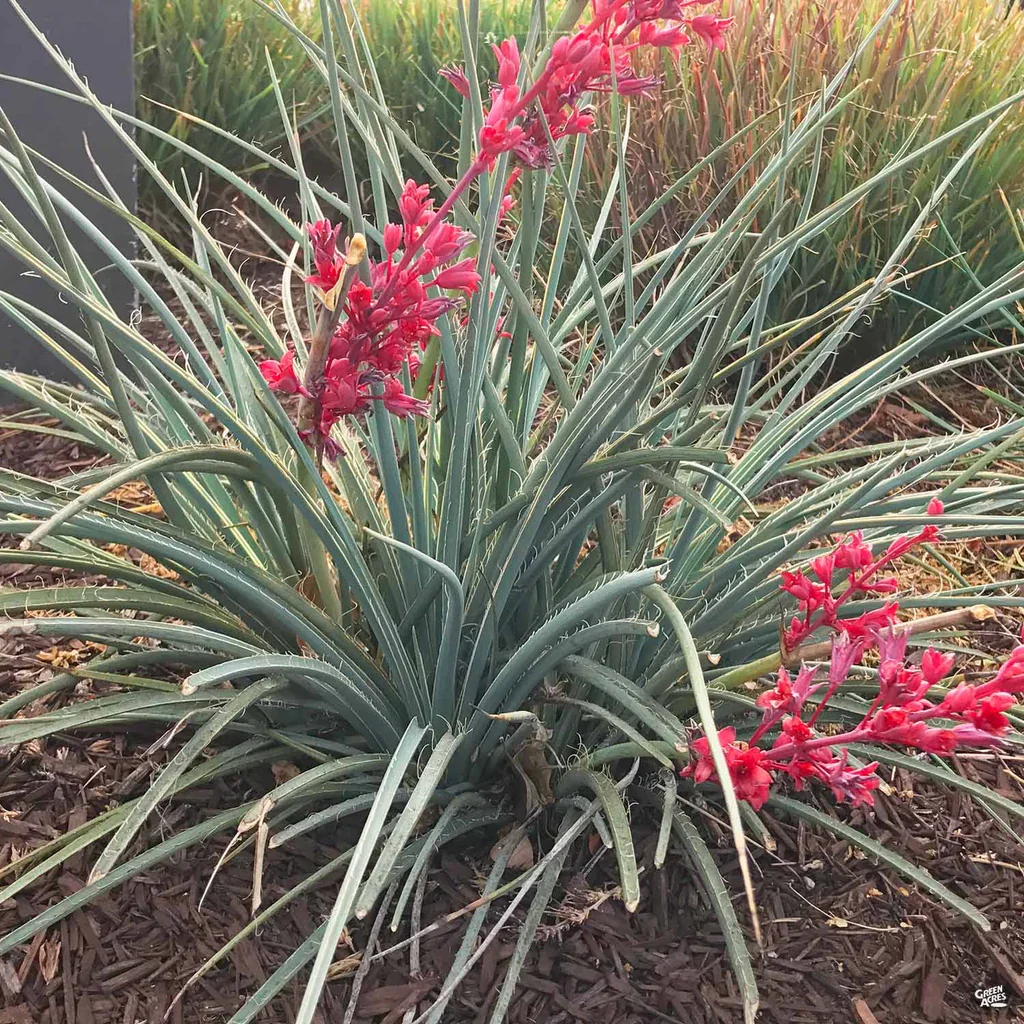
Straight Up Red Texas Yucca is a distinctive waterwise perennial valued for its sturdy, upright flower spikes, red-pink summer blooms, and dense clumps of narrow gray-green foliage. Its consistent plant shape and uniform flowering habit make it especially valuable for mass plantings, contemporary gardens, pollinator landscapes, and other designs where repetition and structure are important.
Despite its common name, Texas yucca is not a true yucca. It belongs to the genus Hesperaloe and combines the architectural appearance of a yucca with graceful, flexible foliage and an exceptionally long flowering season.
Tall flower stalks rise above the evergreen leaves during summer and carry tubular, nectar-rich blooms that attract hummingbirds, butterflies, bees, and other pollinators. Because the flowers rarely produce seed, the plant can direct more energy into its extended floral display.
Straight Up Red is a High Country Gardens introduction recognized as the 2017 High Country Gardens Plant of the Year for its exceptional foliage uniformity, sturdy flower stalks, and long-lasting garden performance.
Why We Grow It at 19 Birch Lane
At 19 Birch Lane, Straight Up Red Texas Yucca represents an opportunity to showcase a different style of perennial gardening—one centered on architectural form, water conservation, dramatic vertical flowers, and plants adapted to sunny, well-drained conditions.
Its red-pink blooms provide strong summer color while its gray-green foliage creates structure before and after flowering. It also demonstrates how drought-tolerant plants can contribute beauty, pollinator value, and four-season texture without requiring frequent irrigation.
In a Maine garden, careful placement is especially important. Straight Up Red should be grown in a sunny, protected location with exceptionally good drainage, particularly during winter. A raised bed, gravel garden, south-facing slope, or planting near heat-retaining stone can help create the conditions this plant needs.
Quick Facts
Botanical Name:Hesperaloe parviflora ‘Straight Up Red’
Common Name: Straight Up Red Texas Yucca
Plant Type: Evergreen Succulent-Like Perennial
Family: Asparagaceae
Patent Status: Plant Patent Applied For
Hardiness Zones: 5–9
Growth Habit: Upright, Clump Forming
Growth Rate: Moderate
Bloom Time: Summer
Bloom Duration: Long Blooming
Flower Color: Red to Deep Pink
Foliage Color: Gray-Green
Foliage Form: Narrow, Sword-Shaped, Arching
Sun Exposure: Full Sun
Water Requirements: Low Once Established
Maintenance: Easy
Pollinator Friendly: Yes
Deer Resistance: Yes
Rabbit Resistance: Yes
Drought Tolerance: Excellent
Coastal Tolerance: Yes
Urban Tolerance: Yes
Award: High Country Gardens Plant of the Year, 2017
Growing Conditions
Light Requirements
Straight Up Red performs best in:
Full Sun
Open, Unshaded Locations
South-Facing Gardens
Areas Receiving at Least Six Hours of Direct Sunlight
Full sun encourages upright flower stalks, dense foliage, and the most abundant flowering.
Too much shade can result in weaker growth, reduced flowering, and a less uniform habit.
Soil Requirements
For best performance, plant Straight Up Red in soil that is:
Lean to Moderately Fertile
Sandy
Gravelly
Rocky
Fast Draining
Low in Organic Matter
Never Consistently Wet
This plant is highly sensitive to soggy soil, especially during winter dormancy. Excellent drainage is more important than soil fertility.
In heavier soils, consider planting it in:
A raised bed
A gravel garden
A berm or slope
A container with generous drainage
Soil amended with coarse mineral material
Avoid placing it in low areas where water collects after rain or snowmelt.
Water Requirements
Straight Up Red requires regular watering only while becoming established.
During Establishment
Water deeply after planting.
Provide periodic water during the first growing season.
Allow the soil to dry somewhat between waterings.
Encourage roots to grow deeply rather than watering lightly and frequently.
Once Established
Reduce watering frequency.
Water during extended dry periods.
Avoid constantly moist soil.
Do not irrigate on a fixed schedule if rainfall is adequate.
Although highly drought tolerant, occasional deep watering can support stronger flowering during prolonged summer drought.
Cold-Climate and Winter Considerations
Straight Up Red is listed for USDA Zones 5–9, placing it near the colder edge of its range in Midcoast Maine.
For the greatest chance of long-term success at 19 Birch Lane:
Select a protected south- or southwest-facing location.
Provide exceptional winter drainage.
Avoid low areas where snowmelt accumulates.
Keep heavy organic mulch away from the crown.
Use gravel around the base rather than moisture-retentive mulch.
Protect young plants from severe winter exposure.
Avoid late-season fertilization that encourages tender growth.
Consider growing it in a large container that can be protected during extreme winters.
In colder areas, foliage may experience winter damage even when the crown survives. Damaged leaves can be removed in spring as new growth begins.
Flower Characteristics
Straight Up Red is valued for its upright and unusually uniform flower display.
Flower Features
Red to deep pink tubular flowers
Tall, sturdy flower stalks
Upright flowering habit
Long summer bloom period
Nectar-rich blossoms
Excellent color above architectural foliage
Flowers that rarely produce seed
Strong consistency in mass plantings
The upright flower spikes create a strong vertical accent and contrast beautifully with the plant’s low, fountain-like foliage.
Because the flowers rarely set seed, flowering can continue for an extended period rather than ending quickly after pollination.
Foliage Characteristics
The foliage provides ornamental value throughout the growing season and may remain evergreen where winters are mild enough.
Foliage Features
Narrow, sword-shaped leaves
Gray-green coloration
Dense clump-forming habit
Consistent leaf shape and size
Graceful arching form
Excellent year-round texture
Strong architectural presence
Useful contrast with broad-leaved plants
Although the leaves resemble those of a yucca, they are generally more flexible and less rigid than many true yuccas.
The foliage gives Straight Up Red a sculptural quality that works especially well in contemporary, Mediterranean-inspired, gravel, and waterwise gardens.
Pollinator and Wildlife Benefits
Straight Up Red is a valuable nectar plant for summer wildlife.
Attracts
Hummingbirds
Butterflies
Bees
Native Pollinators
Beneficial Insects
The tubular flowers are particularly well suited to hummingbirds, which can access nectar deep within the blooms.
Its long flowering season provides a dependable food source during summer when pollinator activity is high.
Deer, Rabbit, Coastal, and Urban Tolerance
Straight Up Red offers resistance to several common landscape challenges.
It is considered:
Deer resistant
Rabbit resistant
Drought tolerant
Heat tolerant
Coastal-exposure tolerant
Moderately salt tolerant
Tolerant of urban pollution
Well adapted to lean soils
Young plants may still require temporary protection from deer and rabbits while becoming established.
No plant is completely browse-proof, particularly during periods of food scarcity.
Garden Uses
Straight Up Red is an exceptional choice for sunny gardens where strong form, summer color, and low water use are priorities.
Recommended Uses
Xeric Gardens
Waterwise Landscapes
Gravel Gardens
Rock Gardens
Pollinator Gardens
Hummingbird Gardens
Contemporary Landscapes
Coastal Gardens
Urban Plantings
Mass Plantings
Perennial Borders
Foundation Beds
Raised Beds
Slope Plantings
Large Containers
Specimen Plantings
Cut Flower Gardens
Botanical Collections
The plant’s uniformity makes it particularly effective when repeated in groups or planted in rhythmic patterns.
Companion Plants
Straight Up Red combines well with plants that tolerate sun, heat, and freely draining soil.
Recommended Companion Plants
Hens and Chicks
Blue Fescue
Little Bluestem
Switchgrass
Lavender
Yarrow
Sea Holly
Artemisia
Coreopsis
Creeping Thyme
Drought-Tolerant Ornamental Grasses
The red-pink flowers stand out beautifully against silver, blue, gray-green, chartreuse, and deep burgundy foliage.
Avoid pairing it with moisture-loving plants that require frequent irrigation, as their cultural needs are incompatible.
When companion Plant Finder listings are available, these plant names should be internally linked to their corresponding 19 Birch Lane pages.
Care and Maintenance
Straight Up Red is easy to maintain when planted in the correct conditions.
Planting Tips
Choose the sunniest available location.
Confirm that the soil drains rapidly.
Avoid amending the planting hole with excessive compost.
Set the crown at or slightly above the surrounding soil level.
Water thoroughly after planting.
Allow sufficient space for mature clump development.
Use gravel mulch to keep the crown dry.
Avoid placing irrigation emitters directly against the crown.
Proper planting is especially important in cold climates, where excessive winter moisture can be more damaging than low temperatures.
Ongoing Maintenance
Water periodically during the first growing season.
Reduce irrigation once established.
Feed lightly in early spring.
Avoid excessive nitrogen fertilizer.
Remove spent flower stalks for a neater appearance.
Remove damaged foliage in spring.
Protect young plants from animal browsing.
Avoid piling organic mulch against the crown.
Monitor winter drainage.
Straight Up Red does not require frequent division or pruning.
Fertilizing
This plant performs best in relatively lean soil.
A light feeding in early spring may support healthy growth, but excessive fertilizer can cause:
Soft foliage
Reduced structural strength
Increased cold sensitivity
Excessive growth at the expense of flowering
Use a balanced, slow-release fertilizer sparingly, or apply a light layer of compost around—but not directly over—the crown.
Landscape Design Ideas
Straight Up Red can introduce strong vertical form and a distinctive southwestern character into northern gardens.
Use it:
In repeated groups along a sunny pathway
Within a gravel or rock garden
Against dark evergreen foliage
Near stone walls or gravel surfaces
In a raised south-facing border
As a focal point in a large container
Among ornamental grasses
In a pollinator or hummingbird garden
Near patios where the flowers can be observed closely
As a rhythmic accent in mass plantings
In a contemporary garden with simplified planting combinations
For a cohesive design, repeat Straight Up Red at measured intervals rather than scattering isolated specimens throughout the landscape.
Its upright flowers can be used to echo the vertical lines of an arbor, pergola, fence, or architectural structure.
Why Gardeners Love Straight Up Red
✔ Long summer bloom period
✔ Red-pink hummingbird flowers
✔ Strong upright flower stalks
✔ Uniform growth and flowering
✔ Architectural gray-green foliage
✔ Excellent drought tolerance
✔ Low maintenance
✔ Deer and rabbit resistant
✔ Pollinator friendly
✔ Suitable for coastal exposure
✔ Strong performance in mass plantings
✔ Evergreen texture in suitable conditions
✔ High Country Gardens 2017 Plant of the Year
Plant Finder Details
Botanical Name:Hesperaloe parviflora ‘Straight Up Red’
Common Name: Straight Up Red Texas Yucca
Plant Type: Evergreen Succulent-Like Perennial
Family: Asparagaceae
Patent Status: Plant Patent Applied For
Native Heritage: Cultivar of a species native to Texas and northeastern Mexico
Hardiness Zones: 5–9
Growth Rate: Moderate
Bloom Time: Summer
Bloom Duration: Long Blooming
Flower Color: Red to Deep Pink
Flower Form: Tubular Flowers on Upright Spikes
Foliage Color: Gray-Green
Foliage Form: Narrow, Sword-Shaped, Arching
Growth Habit: Dense, Upright, Clump Forming
Sun Exposure: Full Sun
Water Requirements: Low Once Established
Soil Requirements: Lean, Sandy, Rocky, Gravelly, Well Drained
Maintenance: Easy
Pollinator Friendly: Yes
Attracts Hummingbirds: Yes
Attracts Butterflies: Yes
Attracts Bees: Yes
Deer Resistance: Yes
Rabbit Resistance: Yes
Drought Tolerance: Excellent
Coastal Exposure: Tolerant
Urban Pollution: Tolerant
Container Friendly: Yes
Award: High Country Gardens Plant of the Year, 2017
📍 Where to Find This Plant at 19 Birch Lane
Straight Up Red Texas Yucca is best suited to one of the sunniest and most freely draining areas at 19 Birch Lane.
An ideal location would be within a future:
Gravel Garden
Waterwise Garden
Rock Garden
Pollinator Garden
South-Facing Perennial Border
Protected Courtyard Planting
Large Seasonal Container Display
Because its exact permanent garden location has not been provided, this section should be updated after the plant is installed. Recording its specific location will help visitors find it while strengthening the connection between the online Plant Finder and the living collections at 19 Birch Lane.
🌸 Seasonal Interest Calendar
🌱 Spring
Evergreen or semi-evergreen gray-green foliage becomes more active as temperatures warm. Any winter-damaged leaves can be removed, revealing fresh growth from the center of the clump.
☀️ Summer
Tall, sturdy flower stalks rise above the foliage and carry red-pink tubular blooms over an extended period. Hummingbirds, butterflies, bees, and other pollinators visit the nectar-rich flowers.
🍂 Fall
The architectural foliage continues adding texture after flowering ends. Spent flower stalks may be removed for a cleaner appearance, or briefly retained if their structure contributes to the garden design.
❄️ Winter
In milder areas, the gray-green foliage remains evergreen. In colder northern gardens, leaves may experience winter damage while the protected crown remains alive below or near the soil surface. Excellent drainage is critical during freeze-thaw cycles and spring snowmelt.
🎓 Garden Design Tips from 19 Birch Lane
At 19 Birch Lane, we recommend treating Straight Up Red Texas Yucca as an architectural feature rather than simply another flowering perennial. Its dense fountain of narrow foliage provides structure throughout the season, while the upright flower spikes add height without creating a heavy visual mass.
Place the plant where its complete outline can be seen—near a gravel path, stone terrace, low wall, or open section of a sunny border. Avoid crowding it with floppy or moisture-loving plants that may obscure the foliage or require excessive irrigation.
For the strongest visual effect, plant Straight Up Red in repeated groups with consistent spacing. Combine it with lower, rounded plants such as sedums, creeping thyme, hens and chicks, or compact artemisia, then add airy grasses or blue-flowering perennials for contrast.
The red-pink blooms work especially well with:
Blue-gray foliage
Silver foliage
Deep burgundy leaves
Golden ornamental grasses
Pale stone
Dark painted structures
Weathered wood
Gravel and natural rock
In Midcoast Maine, position it in a protected microclimate where the soil remains dry during winter. A south-facing slope or raised gravel bed near heat-retaining stone can improve both winter survival and flowering performance.
🌿 Plants That Grow Well with Straight Up Red at 19 Birch Lane
Straight Up Red combines best with sun-loving plants that appreciate similar dry, well-drained conditions.
Recommended companions include:
Sedum
Hens and Chicks
Blue Fescue
Little Bluestem
Russian Sage
Catmint
Sea Holly
Silver Mound Artemisia
SunFern™ Olympia Artemisia
Yarrow
Coneflower
Coreopsis
Lavender
Creeping Thyme
Drought-Tolerant Ornamental Grasses
Whenever possible, link each companion to its individual 19 Birch Lane Plant Finder listing. This internal linking helps visitors discover related plants while improving website navigation, topical authority, SEO, and AI-search visibility.
Frequently Asked Questions
Is Straight Up Red a true yucca?
No. Despite the common name Texas yucca, it belongs to the genus Hesperaloe. It has a yucca-like appearance but generally produces more flexible foliage and long-blooming tubular flowers.
How much sun does Straight Up Red need?
It performs best in full sun with at least six hours of direct sunlight each day.
Is Straight Up Red hardy in Maine?
It is listed for USDA Zones 5–9, but Midcoast Maine is near the colder edge of its range. A protected location with exceptional winter drainage will provide the greatest chance of success.
Does it need frequent watering?
No. Water regularly during the first growing season, then reduce irrigation once the plant is established. Periodic deep watering during extended drought can improve flowering.
What type of soil does it need?
It requires lean, fast-draining soil. Sandy, gravelly, rocky, or raised planting areas are preferable to heavy, moisture-retentive soil.
Does Straight Up Red attract hummingbirds?
Yes. Its tubular red-pink flowers are highly attractive to hummingbirds.
Is it useful for butterflies and bees?
Yes. The long-lasting, nectar-rich flowers attract butterflies, bees, and other beneficial pollinators.
Is Straight Up Red deer resistant?
It is considered deer resistant, though young plants may still need protection while becoming established.
Is it rabbit resistant?
Yes, established plants are generally considered rabbit resistant. Tender young growth may still be vulnerable.
Is the foliage evergreen?
It is evergreen in warmer parts of its growing range. In colder northern climates, the foliage may experience winter damage or behave as semi-evergreen.
Does it require deadheading?
Deadheading is not essential for plant health, but removing spent flower stalks creates a cleaner appearance.
Can it grow in a container?
Yes. Use a large container with excellent drainage and a gritty growing mix. In colder climates, container-grown plants may need winter protection.
Is it suitable for coastal gardens?
Yes. It tolerates coastal exposure and some salt, provided the planting site drains well.
Why does it bloom for so long?
The nectar-rich flowers rarely produce significant seed, allowing the plant to continue flowering over an extended period.
Can it be propagated at home?
This cultivar is protected under plant patent law. Asexual propagation is prohibited during the life of the patent without authorization.
Botanical Garden Notes
Straight Up Red Texas Yucca demonstrates how architectural foliage, water conservation, and wildlife support can be combined within a single ornamental plant.
Its cultivar selection emphasizes uniformity—both in foliage size and the shape of its sturdy flowering stems. This consistency makes it especially valuable in formal mass plantings where irregular plant size would weaken the intended design.
As a High Country Gardens introduction and its 2017 Plant of the Year, Straight Up Red also reflects the growing interest in resilient plants that can thrive with fewer resources while still providing a strong ornamental display.
Within the developing collections at 19 Birch Lane, it could help tell the story of waterwise gardening, climate-adapted planting, pollinator support, and the role of regional microclimates in expanding the range of plants that can be grown successfully in Maine.
Straight Up Red Texas Yucca (Hesperaloe parviflora ‘Straight Up Red’)
A Long-Blooming, Waterwise Perennial with Upright Red-Pink Flowers and Architectural Evergreen Foliage