
How to Design a Garden That Blooms From Spring Through Fall: Our Strategy at 19 Birch Lane
A Zone 6 Guide to Continuous Color, Succession Planting and Four-Season Garden Design
A beautiful garden shouldn't have only one great moment.
One of the questions we continually ask while designing the gardens at 19 Birch Lane in Mid Coast Maine is:
What will be happening here next?
When the daffodils finish, what replaces them?
When the irises fade, what is beginning to flower?
When the roses slow down, where will your eye travel next?
And when September arrives, will the garden still feel as intentional as it did in June?
Creating a garden that blooms from spring through fall isn't about filling every available space with flowers. It's about understanding bloom succession—designing layers of plants so that as one group reaches its peak, another is preparing to take its place.
At 19 Birch Lane, where we garden in USDA Zone 6a along the coast of Maine, this has become one of the most important principles behind our garden design.
We grow hellebores, spring bulbs, irises, peonies, roses, catmint, daylilies, hydrangeas, dahlias, Japanese anemones, ornamental grasses and dozens of other perennials, shrubs and trees.
But the individual plants are only part of the story.
The real magic comes from how they work together.
What Is Succession Planting in a Flower Garden?
Succession planting simply means selecting and arranging plants so different groups reach their peak at different times.
Think of your garden as a performance.
You don't want every performer on stage during the opening act.
Instead, plants enter and leave the spotlight throughout the season.
In a well-designed perennial garden, there may be several things happening simultaneously:
One plant is flowering.
Another is developing buds.
Another has just finished flowering but still has attractive foliage.
A shrub is beginning to change color.
An ornamental grass is developing seed heads.
Bulbs underneath everything are preparing for next spring.
That's the difference between planting flowers and designing a garden.
At 19 Birch Lane, we increasingly design with the entire growing season in mind.
Our First Rule: Never Design Around a Single Month
It's incredibly easy to visit a garden center in June, purchase everything that's flowering beautifully and accidentally create a garden that looks spectacular every June—and ordinary for the rest of the year.
We've learned to ask a different question:
What does this plant contribute before, during and after it flowers?
A perennial that blooms for three weeks but has beautiful foliage for five months may be more valuable than something with spectacular flowers and unattractive foliage afterward.
Likewise, a shrub that flowers briefly but provides structure all season can become one of the most important plants in a border.
This is why our garden plans combine:
Spring bulbs + perennials + shrubs + roses + grasses + trees + late-season flowers.
Each layer has a job.
Early Spring: Start Before Most People Think the Garden Has Begun
In Maine, early spring can be unpredictable.
Snow may still be lingering in shaded areas while sunny garden beds begin waking up.
For us, the gardening season doesn't begin with tulips.
It begins earlier.
Early Spring Plants We Use
Hellebores
Hellebores are among our favorite plants for beginning the season.
Their nodding flowers appear when relatively little else is happening, particularly in partially shaded and woodland-style areas.
Even better, their foliage provides garden interest long after flowering.
Dwarf Irises
Small early-flowering irises bring intense color to the garden before their taller relatives appear.
They're particularly effective when planted where people naturally walk in early spring.
Daffodils and Other Spring Bulbs
Bulbs are one of the easiest ways to extend the flowering season.
We like them planted through existing perennial gardens, rather than isolated in separate beds.
Why?
Because the emerging perennial foliage eventually helps conceal declining bulb leaves.
That relationship between plants is exactly what succession gardening is about.
Mid-Spring: Build Momentum
As temperatures rise, the garden begins changing rapidly.
Now we're moving from scattered early flowers toward larger masses of color.
Plants such as:
Brunnera
Pulmonaria
Bleeding hearts
Columbine
Spring bulbs
Early irises
Flowering shrubs
begin overlapping.
At this point, foliage also becomes increasingly important.
Hostas begin unfurling.
Peonies push upward.
Daylily foliage forms fresh green clumps.
Hydrangeas begin leafing out.
The garden doesn't need everything flowering because the architecture of the plants themselves is beginning to return.
Late Spring: Let the Irises Take the Stage
Few plants create the kind of architectural drama that irises provide.
At 19 Birch Lane, our expanding iris collection is particularly important because different iris groups can help extend the season.
Their sword-like foliage creates strong vertical lines while their flowers rise above surrounding plants.
We like pairing irises with softer plants.
For example:
Iris + Catmint
The strong vertical foliage and upright flowers of irises contrast beautifully against the loose, billowing habit of catmint.
Iris + Peony
Irises provide vertical structure while peonies provide rounded foliage and enormous flowers.
Iris + Ornamental Alliums
The spherical flowers of alliums create another completely different shape.
This brings us to another principle we use constantly:
Contrast shapes, not just colors.
Early Summer: Peonies, Catmint and Roses Change the Garden
By early summer, the character of the gardens shifts again.
This is one of the richest transitions of the entire season.
Peonies begin flowering.
Catmint becomes a haze of lavender-blue.
Salvias provide upright flower spikes.
And roses begin taking center stage.
At 19 Birch Lane, our collection of David Austin English Roses is especially important during this period.
Their flowers introduce something beyond color:
fragrance.
Garden design should involve more than what visitors see.
We want people to experience:
Fragrance
Movement
Sound
Texture
Temperature
Wildlife
Walking past fragrant roses or brushing against aromatic lavender creates memories that a photograph alone cannot capture.
Midsummer: Daylilies Keep the Color Moving
By midsummer, many spring perennials have finished.
This is exactly when daylilies become invaluable.
Our growing daylily collection allows us to introduce an entirely new color palette into the gardens.
Different cultivars can provide:
Yellow
Apricot
Orange
Red
Pink
Burgundy
Lavender
Near-white
Multicolored flowers
And because individual cultivars flower at slightly different times, collecting multiple varieties can extend the display significantly.
Daylilies work particularly well alongside:
Hydrangeas
Coneflowers
Catmint
Ornamental grasses
Rudbeckia
Coreopsis
The trick isn't to think:
“What looks good beside a daylily?”
Instead ask:
“What will be flowering before and after this daylily?”
That small change in thinking creates a much longer season.
Hydrangeas: The Bridge Between Summer and Fall
Hydrangeas are among the most valuable shrubs in our gardens for maintaining late-season interest.
As many early perennials finish, hydrangeas are just getting started.
At 19 Birch Lane, we grow and continue adding different types of hydrangeas, including larger plantings designed to create substantial masses of color.
Depending on the type and cultivar, hydrangea flowers can remain attractive for an extraordinarily long period.
And the flowers don't simply disappear.
They evolve.
Fresh summer blossoms mature into deeper, muted tones that can remain attractive into fall.
That makes hydrangeas excellent transition plants.
They connect summer to autumn.
Late Summer: Dahlias Take Over
If spring belongs to bulbs and irises, late summer belongs to dahlias.
Dahlias are remarkable because they reach their stride precisely when many other flowering plants are beginning to tire.
Their diversity is extraordinary.
There are:
Dinner-plate dahlias
Decorative dahlias
Ball dahlias
Pompon forms
Cactus forms
Single-flowered varieties
And the color range is nearly limitless.
Our expanding dahlia collection allows us to inject intense color into the gardens late in the growing season.
That's another important lesson:
Save some of your biggest performers for later.
If every spectacular plant blooms in June, August will inevitably feel disappointing.
Early Fall: Don't Let the Garden Quit
September in a Zone 6 garden can be extraordinary.
The temperatures begin cooling.
The light changes.
Hydrangeas deepen in color.
Ornamental grasses mature.
And several late-season perennials reach their peak.
One of our favorites is:
Japanese Anemone
Japanese anemones bring an entirely different character to the autumn garden.
Their flowers float above tall stems, adding movement and lightness just when the garden begins becoming heavier with mature foliage.
We also rely on late-season plants such as:
Sedum
Asters
Reblooming irises
Dahlias
Hydrangeas
Rudbeckia
Ornamental grasses
Rather than viewing fall as the end of the garden, we design it as another season entirely.
Ornamental Grasses: The Plants That Connect Everything
Grasses are some of the hardest-working plants in our gardens.
They may not always command attention in spring, but as the season progresses, they become increasingly important.
Their foliage provides:
Texture
Movement
Height
Repetition
Then their seed heads add another layer in late summer and fall.
We especially appreciate grasses near flowering perennials because they provide a visual resting place between stronger colors.
When the breeze moves through them, they also introduce motion into the landscape.
And here in coastal Maine, where breezes are part of the garden experience, movement matters.
Foliage Is Just as Important as Flowers
One of the biggest changes in our own garden design has been learning to pay more attention to foliage.
Flowers are temporary.
Leaves are present for months.
A garden made entirely from plants selected for their flowers can become surprisingly monotonous between bloom periods.
Instead, combine different foliage:
Fine Texture
Grasses and delicate perennials.
Broad Texture
Hostas and hydrangeas.
Upright Texture
Irises and ornamental grasses.
Mounded Forms
Catmint and many compact perennials.
Woody Structure
Boxwoods, hydrangeas and other shrubs.
This creates interest even when relatively little is flowering.
Use Height to Create Layers
Another principle we use at 19 Birch Lane is vertical layering.
Rather than arranging plants randomly, think about a garden as several levels.
Front Layer
Low-growing plants and groundcovers.
Examples:
Catmint
Heuchera
Low sedums
Middle Layer
Medium-height perennials.
Examples:
Daylilies
Peonies
Coneflowers
Irises
Back Layer
Tall perennials, grasses and shrubs.
Examples:
Hydrangeas
Tall ornamental grasses
Delphiniums
Large roses
Upper Layer
Trees.
Trees provide the ceiling of the garden.
This layering creates depth and makes relatively small garden spaces feel much larger.
Repetition Makes a Garden Feel Intentional
If we could give gardeners one simple design technique that immediately makes a landscape feel more professional, it would be:
Repeat plants.
Don't buy one of everything.
Plant three.
Five.
Seven.
Or create larger drifts when space allows.
Then repeat that plant somewhere else in the garden.
For example, catmint might appear beside one path and then reappear fifty feet away.
Hydrangeas might anchor several different garden areas.
The same ornamental grass can repeat throughout multiple borders.
Repetition tells your eye:
These spaces belong together.
Don't Forget the Quiet Moments
A garden doesn't need to scream for attention everywhere.
In fact, it shouldn't.
Strong garden design needs moments of excitement and moments of rest.
A spectacular rose garden feels more dramatic when you approach it through a quieter landscape.
A colorful perennial border feels richer when contrasted with lawn.
A statue becomes more powerful when surrounded by simple foliage.
Negative space is part of garden design.
So is restraint.
Our Spring-to-Fall Bloom Strategy at 19 Birch Lane
When we're planning a new garden, we mentally divide the season into several overlapping periods.
Season Plants Taking the Lead Early Spring Hellebores, dwarf irises, daffodils, spring bulbs Mid-Spring Brunnera, pulmonaria, bleeding hearts, bulbs Late Spring Irises, alliums, peonies Early Summer Roses, catmint, salvia, peonies Midsummer Daylilies, coneflowers, hydrangeas, coreopsis Late Summer Hydrangeas, dahlias, rudbeckia, grasses Early Fall Dahlias, Japanese anemones, hydrangeas, sedum, reblooming irises Late Fall Ornamental grasses, seed heads, foliage, structural shrubs
Notice something important:
Every period overlaps the next.
That's intentional.
There should never be a hard stop where one garden season ends and another begins.
The transitions should feel gradual.
What Happens When a Plant Finishes Blooming?
This is an important question that doesn't receive enough attention.
When a flower finishes, we consider three things:
1. Does the foliage still look attractive?
If yes, leave it and allow it to contribute texture.
2. Will deadheading encourage reblooming?
Plants such as catmint can often provide another flush after being trimmed.
3. Will the seed head add interest?
Not everything needs to be cut down immediately.
Coneflowers and ornamental grasses can remain beautiful long after flowering while also providing ecological value.
Knowing when not to cut something is an important gardening skill.
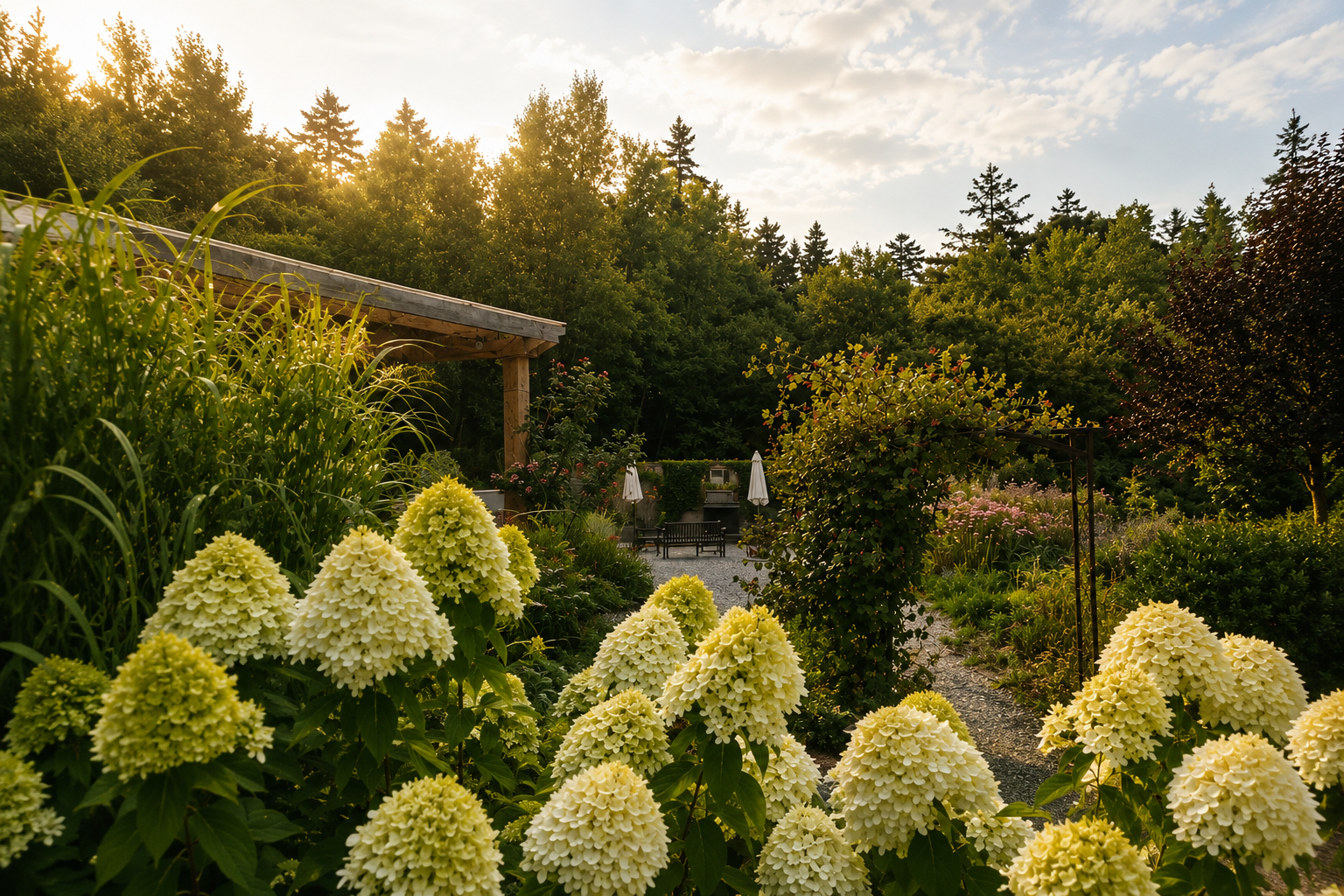
Grasses and hydrangeas are great plans to add bold textures and height to any garden.
How Many Different Plants Do You Need for Continuous Bloom?
Probably fewer than you think.
The secret isn't necessarily enormous plant diversity.
It's choosing plants with complementary seasons.
For a smaller Zone 6 garden, you could build an excellent succession using:
Hellebores
Daffodils
Irises
Peonies
Catmint
Roses
Daylilies
Hydrangeas
Coneflowers
Dahlias
Japanese anemones
Ornamental grasses
Twelve carefully selected plant groups could create months of changing interest.
Then expand the collection as your garden evolves.
The Most Important Lesson We've Learned
After creating and expanding garden after garden at 19 Birch Lane, our philosophy has become surprisingly simple:
Don't design for the photograph. Design for the calendar.
A photograph captures one second.
A garden has to perform for months.
Think about March.
Think about May.
Think about July.
Think about September.
Think about November.
Ask what visitors—or you—will experience during each one.
That's how a collection of beautiful plants becomes a garden.
Creating a Garden That Gets Better Every Year
Perhaps the greatest advantage of perennial gardening is that patience is rewarded.
A newly planted border rarely looks like the vision in your head.
The first year can feel sparse.
The second begins filling.
By the third and fourth seasons, plants begin interacting with one another.
Shrubs gain presence.
Perennials form substantial clumps.
Grasses create movement.
Trees begin providing shade.
And suddenly the garden starts feeling as though it has always been there.
That's the process we're experiencing throughout 19 Birch Lane.
Every year, the gardens become fuller.
Every year, we learn something.
Every year, we add another collection.
And every year, the flowering calendar becomes a little longer.
Our goal isn't simply to create a garden with beautiful flowers.
It's to create a landscape that always gives you a reason to wonder:
What's blooming next?
Frequently Asked Questions: Designing a Garden That Blooms All Season
How do I create a garden that blooms from spring through fall?
Choose plants with overlapping bloom periods rather than selecting everything for peak summer. Combine early bulbs and hellebores with spring irises and peonies, early-summer roses and catmint, midsummer daylilies and hydrangeas, and late-season dahlias, Japanese anemones and ornamental grasses.
What are some of the best perennials for continuous color in Zone 6?
At 19 Birch Lane, some of our most useful plants include hellebores, irises, peonies, catmint, daylilies, coneflowers, Japanese anemones and ornamental grasses. We combine these with flowering shrubs, roses, hydrangeas, bulbs and annuals to extend the season further.
How do you keep a perennial garden colorful after spring flowers fade?
Overlap bloom periods. Place later-flowering plants near earlier varieties so emerging foliage hides declining spring plants. Hydrangeas, daylilies, coneflowers and dahlias are particularly useful for carrying color through summer and into fall.
Should every plant in a flower garden bloom at the same time?
No. For a long-season garden, it's actually better if they don't. Staggering bloom periods creates continuous change and gives individual plants an opportunity to become focal points.
How do you make a flower garden look good when nothing is blooming?
Design with foliage, plant form, shrubs, trees, ornamental grasses, pathways, stone, sculpture and other structural elements. Flowers should be one component of the garden rather than the only source of visual interest.
What is the easiest way to make a perennial garden look professionally designed?
Repeat key plants throughout the landscape, plant in groups rather than isolated singles, vary plant heights and foliage textures, and leave enough negative space for individual plant combinations to be appreciated.
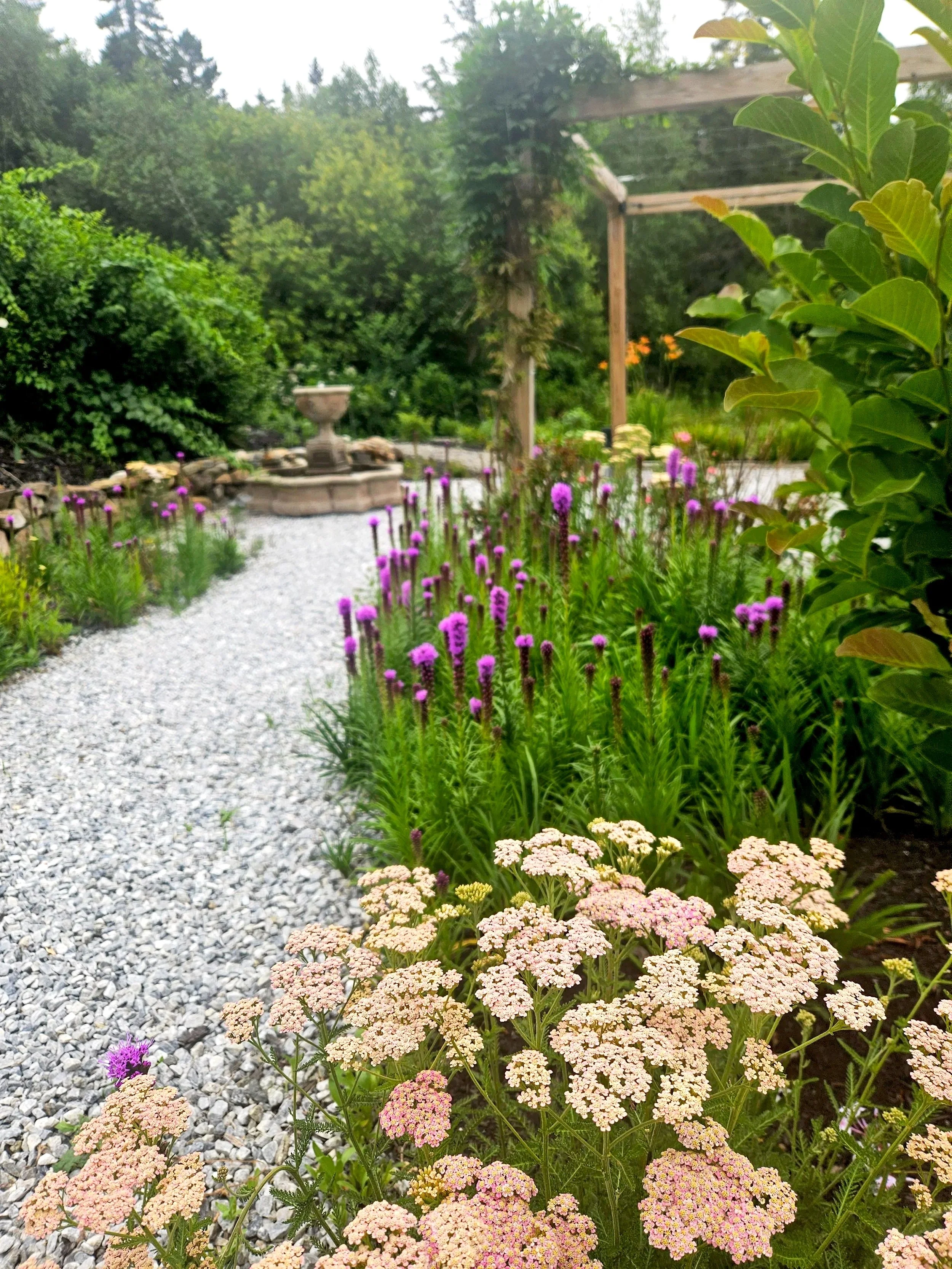
Always have a focal point to draw the eye into a garden.
Growing Along With the Gardens at 19 Birch Lane
As we continue transforming our five acres in Mid Coast Maine, this approach to succession planting and four-season garden design is becoming increasingly important.
We're not simply collecting beautiful plants.
We're learning how those plants interact.
We're studying when they emerge.
When they flower.
What replaces them.
How their foliage changes.
And how they contribute to the larger landscape.
That's part of the journey of building 19 Birch Lane into a botanical destination.
And we'll continue sharing what works—and what doesn't—as the gardens grow.
Because gardening isn't something you master and finish.
The garden teaches you something new every season.