
Haas’ Halo Smooth Hydrangea
Hydrangea arborescens ‘Haas’ Halo’
An Outstanding North American Smooth Hydrangea with Enormous White Lacecap Flowers, Strong Stems & Exceptional Pollinator Value
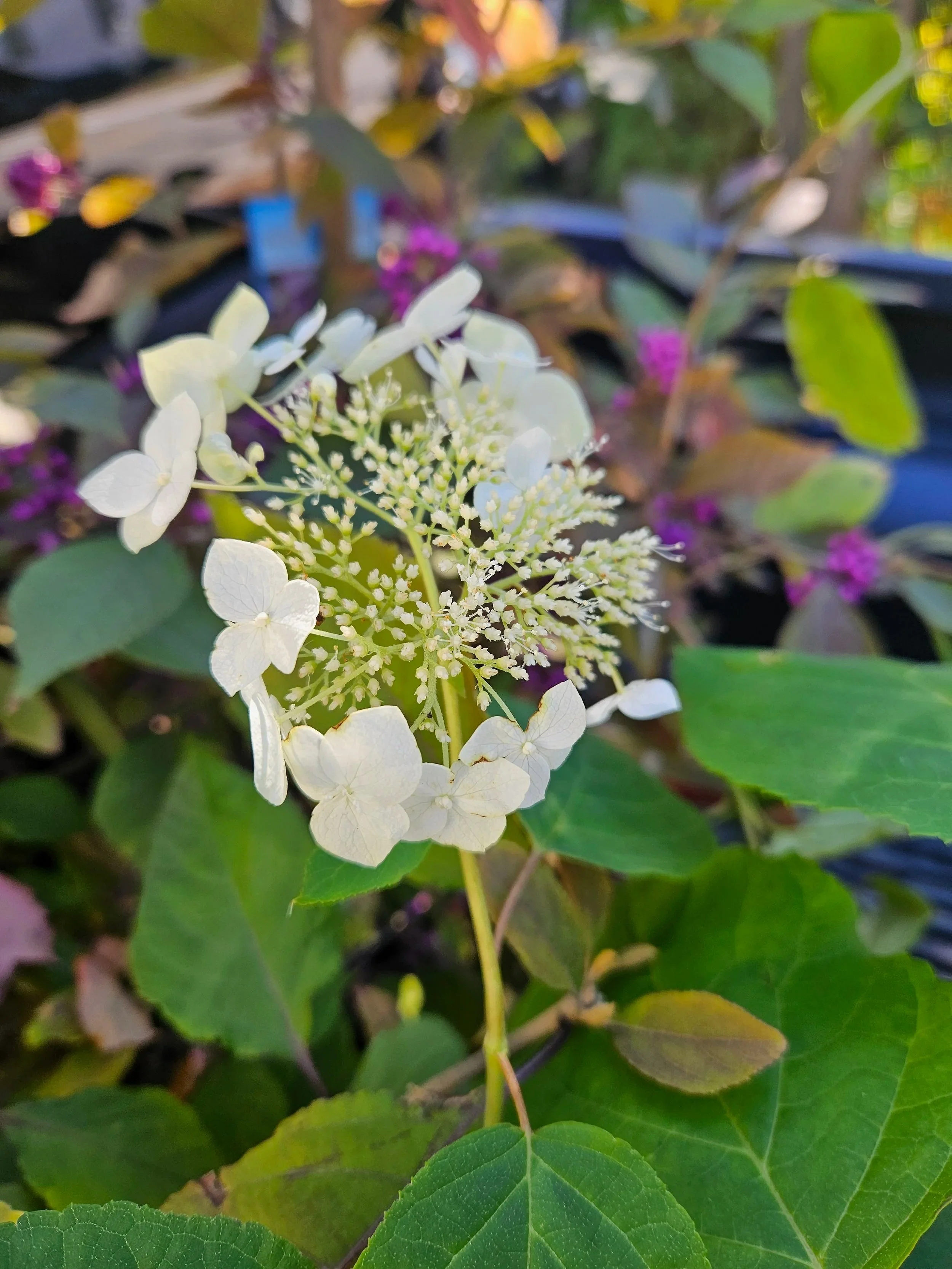
Haas’ Halo Smooth Hydrangea
An Outstanding North American Smooth Hydrangea with Enormous White Lacecap Flowers, Strong Stems & Exceptional Pollinator Value
Plant Overview
Common Name: Haas’ Halo Smooth Hydrangea
Botanical Name: Hydrangea arborescens ‘Haas’ Halo’
Other Common Names: Wild Hydrangea, Smooth Hydrangea
Family: Hydrangeaceae
Plant Type: Deciduous Flowering Shrub
Species Heritage: North American native species
USDA Hardiness Zones: 3–9
Primary Season of Interest: Summer through Winter
Flower Color: White to Greenish White
Flower Type: Lacecap
Growth Habit: Upright, Mounding
Growth Rate: Rapid
Haas’ Halo is one of the most impressive selections of our North American smooth hydrangea, combining enormous white lacecap flowers, sturdy stems, handsome blue-green foliage, excellent cold hardiness, and significant value to pollinators.
Unlike the rounded mophead flowers commonly associated with cultivars such as ‘Annabelle’, Haas’ Halo produces broad, flattened lacecap flower clusters. The flower heads feature showy white sterile florets surrounding numerous smaller fertile flowers—an arrangement that is both ornamental and highly useful to visiting insects. Plant Toolbox
The flower heads commonly reach around 8 inches across, while plants subjected to harder spring pruning may produce even larger blooms. Strong stems help keep those substantial flower clusters upright, even following heavy rain. Plant Toolbox
Its combination of beauty, adaptability, native-species heritage, and ecological value makes Haas’ Halo exactly the type of plant that deserves a place in a modern botanical garden.
Why We Grow It at 19 Birch Lane
Haas’ Halo represents something increasingly important in the development of the gardens at 19 Birch Lane: choosing plants that provide beauty and ecological value at the same time.
There are many spectacular hydrangeas available today.
Haas’ Halo distinguishes itself because the flower structure remains accessible and attractive to pollinators while still creating the dramatic visual effect people expect from a hydrangea.
That gives us an opportunity to use the plant educationally.
Visitors can compare:
Lacecap versus mophead hydrangeas
Fertile versus sterile florets
Native species versus introduced hydrangea species
Pollinator-friendly flower structures
Plants flowering on new wood versus old wood
Cultivar selection within a native species
Sun versus shade performance
Summer flowers versus winter structure
It also gives us another opportunity to demonstrate that native-species cultivars can belong comfortably within highly designed gardens.
Haas’ Halo doesn't have to look wild or informal. It can work equally well in a naturalistic woodland planting, mixed perennial border, formal shrub grouping, or botanical collection.
Quick Facts
Common Name: Haas’ Halo Smooth Hydrangea
Botanical Name: Hydrangea arborescens ‘Haas’ Halo’
Family: Hydrangeaceae
Plant Type: Deciduous Flowering Shrub
Species Origin: Hydrangea arborescens is native to North America
Cultivar Origin: Selected from a Pennsylvania garden
USDA Hardiness Zones: 3–9
Typical Height: Approximately 4–7 feet depending on pruning and conditions
Typical Spread: Approximately 4–7 feet
Growth Habit: Upright, Mounding
Growth Rate: Rapid
Bloom Time: Mid-June through July; timing varies by climate
Peak Flowering: Around midsummer
Flower Color: White
Flower Type: Lacecap
Flower Diameter: Commonly around 8 inches
Foliage: Deep Green to Blue-Green
Sun: Full Sun to Shade
Best Flowering: Generally stronger with adequate sunlight
Soil: Moist, well-drained; adaptable to several soil textures
Water: Moderate
Blooms On: New Wood
Pollinators: Excellent
Attracts: Bees, Butterflies and other flower-visiting insects
Cut Flower: Yes
Dried Flower: Yes
Winter Interest: Dried flower heads
Strong Stems: Yes
Woodland Garden: Excellent
Pollinator Garden: Excellent
Mass Planting: Excellent
North Carolina Extension lists Haas’ Halo for Zones 3–9 and approximately 4–6 feet tall by 3–5 feet wide, while Mt. Cuba's unpruned trial plants reached roughly 7 × 7 feet. That difference is important: pruning and growing conditions can substantially influence mature size. Plant Toolbox
Growing Conditions
Light Requirements
One of Haas’ Halo's strengths is its adaptability.
It can grow in:
Full sun
Part sun
Part shade
Considerable shade
North Carolina Extension reports that it tolerates deep shade but flowers most strongly in full sun. Mt. Cuba found nearly flawless performance under shade conditions as well, with uniform growth and attractive foliage. Plant Toolbox
For Maine, I would consider full sun to partial shade an excellent range, provided plants in sunnier locations receive adequate moisture.
Soil Requirements
Haas’ Halo is relatively adaptable but performs best in soil that is:
Moist
Well drained
Rich in organic matter
Acidic to neutral
It can tolerate clay, loam, and sandy soils when moisture and drainage are appropriate. Plant Toolbox
As with most hydrangeas, constantly saturated soil should be avoided.
Water Requirements
Haas’ Halo appreciates consistent moisture.
New plants should be watered regularly while establishing their root systems.
Once established, monitor during prolonged periods of heat and drought, particularly when planted in full sun.
A layer of organic mulch can help:
Conserve moisture
Moderate root temperatures
Reduce weed competition
Protect the root zone
Gradually improve soil organic matter
Flower Characteristics
The flowers are what immediately distinguish Haas’ Halo from many familiar smooth hydrangeas.
Flower Features
Very large lacecap flower clusters
Commonly around 8 inches across
White sterile outer florets
Numerous fertile central flowers
Excellent pollinator accessibility
Strong upright presentation
Attractive fresh or dried
Flowers remain ornamental as they age
North Carolina Extension describes the blooms as lacecaps up to approximately 8 inches across, with showy sterile white florets surrounding smaller fertile flowers. Plant Toolbox
This fertile-flower component is one reason Haas’ Halo performs so well as a pollinator plant.
An Exceptional Pollinator Hydrangea
This is where Haas’ Halo becomes especially interesting.
Mt. Cuba Center evaluated wild hydrangeas for both ornamental performance and ecological value. Haas’ Halo received a perfect 5.0 overall score, becoming the top performer in the trial. Mt. Cuba Center
Its large lacecap flowers were highly attractive to insect pollinators.
Penn State's discussion of the trial reports 183 pollinator visits to Haas’ Halo during the evaluation. Penn State Extension
That makes Haas’ Halo an excellent teaching plant for explaining why flower structure matters.
A hydrangea can be visually impressive to people while simultaneously providing useful floral resources to insects.
Foliage Characteristics
Haas’ Halo develops substantial deep green to blue-green foliage.
Leaves are generally:
Broad
Ovate to somewhat heart-shaped
Serrated along the edges
Approximately 3–6 inches long
Leathery in appearance
The darker foliage creates an excellent background for the white flowers. Plant Toolbox
Strong Stems
One of the weaknesses of some older smooth hydrangeas is stem strength.
Large flower heads can become heavy after rain and pull stems toward the ground.
Haas’ Halo was specifically selected in part for its upright habit and strong stems. Its patent documentation highlights the sturdy stems and their ability to support its unusually large flower heads. Google Patents
That is an important landscape characteristic in Maine, where summer thunderstorms can quickly test a heavily flowering hydrangea.
Cold Hardiness in Maine
Haas’ Halo is exceptionally well suited to northern gardening from a hardiness standpoint.
It is generally listed for:
USDA Zones 3–9. Plant Toolbox
That gives it a considerable cold-hardiness margin for Zone 6 gardens in coastal and Midcoast Maine.
Even more importantly, smooth hydrangeas flower on new wood.
That means the plant produces flowers on stems developed during the current growing season rather than relying entirely on flower buds carried through the previous winter.
For northern gardeners, that is an important advantage.
Blooms on New Wood
Haas’ Halo flowers on the current season's growth.
This means spring pruning can be used strategically to influence its size and flower display.
Mt. Cuba found that cutting plants back in spring reduced their height from approximately 7 feet to 4 feet while increasing the floral display. Mt. Cuba Center
That gives gardeners two legitimate approaches:
Minimal pruning: Allow a larger, more natural shrub.
Stronger spring pruning: Maintain a shorter plant and encourage particularly substantial flowers.
Garden Uses
Haas’ Halo is highly versatile.
Recommended Uses
Pollinator Gardens
Native Plant Gardens
Mixed Shrub Borders
Perennial Borders
Cutting Gardens
Rain Gardens
Mass Plantings
Specimen Plantings
Foundation Plantings
Naturalistic Gardens
Cottage Gardens
Wildlife Gardens
Winter Interest Gardens
Botanical Collections
Using Haas’ Halo in a Pollinator Garden
This may be one of the best uses for the cultivar.
Rather than treating hydrangea purely as an ornamental backdrop, Haas’ Halo can become part of the active ecological layer of the garden.
Combine it with plants that extend the pollinator season before and after the hydrangea flowers.
That creates a sequence of nectar and pollen resources rather than relying on one short flowering event.
Using Haas’ Halo in a Woodland Garden
Haas’ Halo also performs beautifully in partially shaded woodland-edge conditions.
Its large white lacecap flowers can brighten darker areas beneath taller trees.
Combine it with:
Hostas
Ferns
Hellebores
Brunnera
Astilbe
Japanese Forest Grass
The hydrangea provides height and summer flowers while the lower plants create texture around its base.
Companion Plants
Recommended Companions for 19 Birch Lane
Bee Balm
Joe Pye Weed
Asters
Goldenrod
Black-Eyed Susan
Sedum ‘Autumn Joy’
Hostas
Ferns
Hellebores
Brunnera
Astilbe
For pollinator-focused plantings, prioritize plants that extend the flowering season on either side of Haas’ Halo.
Care & Maintenance
Haas’ Halo is relatively straightforward to maintain.
Focus on:
Adequate moisture
Good drainage
Organic mulch
Appropriate spring pruning
Sufficient growing space
Avoiding unnecessary overfertilization
Its naturally strong stems and vigorous growth make it a particularly useful landscape shrub.
Pruning Haas’ Halo Hydrangea
When Should Haas’ Halo Be Pruned?
Late winter to early spring is the preferred pruning period.
Because Haas’ Halo flowers on new wood, spring pruning does not sacrifice the coming season's bloom in the same way it could with an old-wood flowering hydrangea.
How Hard Should Haas’ Halo Be Pruned?
This depends on the desired effect.
For a larger natural shrub
Remove:
Dead stems
Damaged stems
Weak growth
Poorly positioned branches
Allow much of the existing framework to remain.
For a shorter shrub with larger flowers
Cut the plant back more substantially in spring.
Mt. Cuba's trial demonstrated that spring cutback could reduce plant height substantially while increasing flower-head size. Mt. Cuba Center
This is an excellent example of how pruning can be used as a design tool, not simply maintenance.
Winter Interest
Don't be too quick to remove spent flowers.
Haas’ Halo's dried flower heads can remain attractive well after flowering has finished.
North Carolina Extension specifically notes their late-season and winter interest. Plant Toolbox
In a four-season Maine garden, leaving some flower heads standing can provide:
Winter structure
Texture
Frost-catching seedheads
Snow interest
Then prune as needed before the next growing season.
Why Gardeners Love Haas’ Halo Smooth Hydrangea
✓ Huge white lacecap flowers
✓ Exceptional pollinator value
✓ North American native-species heritage
✓ Top-rated in botanical garden trials
✓ Perfect 5.0 Mt. Cuba trial score
✓ Hardy to Zone 3
✓ Excellent for Maine gardens
✓ Flowers on new wood
✓ Strong upright stems
✓ Excellent rain resistance
✓ Full sun to shade adaptability
✓ Handsome blue-green foliage
✓ Cutting garden value
✓ Dried flowers provide winter interest
✓ Excellent woodland plant
✓ Excellent pollinator garden shrub
✓ Works in formal and naturalistic gardens
✓ Educational value for botanical collections
Plant Finder Details
Common Name: Haas’ Halo Smooth Hydrangea
Botanical Name: Hydrangea arborescens ‘Haas’ Halo’
Family: Hydrangeaceae
Plant Type: Deciduous Flowering Shrub
Species Heritage: North American Native
USDA Zones: 3–9
Height: Approximately 4–7 feet depending on pruning
Spread: Approximately 4–7 feet depending on conditions
Habit: Upright, Mounding
Growth Rate: Rapid
Exposure: Full Sun to Shade
Best Flowering: Good sunlight with adequate moisture
Soil: Moist, Well-Drained
Soil pH: Acidic to Neutral
Bloom: Summer
Peak Bloom: Typically late June in the Mid-Atlantic; later timing is possible farther north
Flower Color: White
Flower Type: Lacecap
Typical Flower Diameter: Approximately 8 inches
Foliage: Deep Green to Blue-Green
Blooms On: New Wood
Pollinator Value: Excellent
Attracts: Bees, Butterflies and other insects
Strong Stems: Yes
Cut Flower: Yes
Dried Flower: Yes
Winter Interest: Yes
Woodland Garden: Excellent
Pollinator Garden: Excellent
📍 Where to Find Haas’ Halo Hydrangea at 19 Birch Lane
Haas’ Halo would fit beautifully into a pollinator-focused planting, mixed shrub border, woodland edge, native-inspired garden, or other location where visitors can observe both its enormous lacecap flowers and the pollinators they attract.
The exact permanent garden location of Haas’ Halo Smooth Hydrangea at 19 Birch Lane has not yet been provided or confirmed for this Plant Finder entry.
Once its permanent location is confirmed, update this section with the exact garden name.
That will allow visitors eventually to use the Plant Finder as a digital guide while walking the gardens at 19 Birch Lane.
🌸 Seasonal Interest Calendar
🌱 Spring
New shoots emerge from the established framework.
This is the primary pruning period.
Gardeners can decide whether to maintain a larger natural shrub or prune more aggressively for a shorter plant with larger flowers.
🤍 Early to Midsummer
Large white lacecap flowers begin opening.
Pollinator activity increases as the fertile flowers become available.
🐝 Summer
This is Haas’ Halo at its peak.
Large white lacecaps rise above deep green foliage while bees, butterflies, and other insects visit the flowers.
🌿 Late Summer
Flowers gradually age while remaining ornamental.
The substantial foliage continues providing structure within the garden.
🍂 Fall
Flowers dry and begin transitioning into architectural seedheads.
❄️ Winter
Dried flower heads can remain standing, catching frost and snow and providing texture in the dormant garden.
🎓 Garden Design Tips from 19 Birch Lane
Haas’ Halo illustrates an important principle we want to emphasize at 19 Birch Lane:
A garden does not have to choose between beauty and ecology.
A strong planting could combine:
Haas’ Halo + Wild Bergamot + Coneflower + Catmint + Asters
That provides changing flower forms, heights, and colors while extending pollinator resources across the season.
For a softer woodland composition:
Haas’ Halo + Hosta + Ferns + Hellebores + Japanese Forest Grass
The large white lacecap flowers become the summer focal point while the foliage plants carry the design before and after bloom.
For a late-season composition:
Haas’ Halo + Japanese Anemone + Sedum ‘Autumn Joy’ + Ornamental Grasses
As the hydrangea flowers age, the surrounding perennials take over the color display.
This is how we prefer to think about plant combinations at 19 Birch Lane—not simply asking what looks good together?, but asking:
What will this part of the garden look like in May, July, September, and January?
🌿 Plants That Grow Well with Haas’ Halo at 19 Birch Lane
Recommended companions include:
Wild Bergamot
Catmint
Joe Pye Weed
Asters
Goldenrod
Black-Eyed Susan
Japanese Anemone
Ferns
Hellebores
Brunnera
Astilbe
Where Plant Finder entries already exist, these names should become contextual internal links.
Frequently Asked Questions
What is Haas’ Halo Hydrangea?
Haas’ Halo is a cultivar of the North American smooth hydrangea, Hydrangea arborescens, known for enormous white lacecap flowers, strong stems, and exceptional pollinator value.
Is Haas’ Halo a native hydrangea?
Haas’ Halo is a cultivar of the North American native species Hydrangea arborescens. It is therefore more precise to describe it as a native-species cultivar rather than a wild local genotype.
How large does Haas’ Halo get?
Expect roughly 4–7 feet tall and potentially a similar width depending on pruning and growing conditions. Mt. Cuba's unpruned trial plants reached approximately 7 × 7 feet. Mt. Cuba Center
How large are Haas’ Halo flowers?
Flower clusters commonly average around 8 inches across, although pruning and growing conditions can influence flower size. Mt. Cuba Center
What color is Haas’ Halo Hydrangea?
The lacecap flowers are primarily white.
When does Haas’ Halo bloom?
It flowers in summer. Mt. Cuba recorded mid-June through early July in Delaware; Maine flowering may occur later depending on local climate and seasonal weather. Mt. Cuba Center
Does Haas’ Halo attract pollinators?
Yes. Pollinator value is one of its outstanding characteristics, and its performance helped earn it the top overall rating in Mt. Cuba Center's smooth hydrangea trial. Mt. Cuba Center
Does Haas’ Halo attract bees?
Yes. Bees are among the insects attracted to its fertile flowers. Plant Toolbox
Does Haas’ Halo attract butterflies?
Yes. North Carolina Extension lists both bees and butterflies among its wildlife visitors. Plant Toolbox
Is Haas’ Halo Hydrangea hardy in Maine?
Yes. Its commonly reported USDA Zone 3–9 range makes it particularly well suited from a cold-hardiness standpoint to many Maine gardens. Plant Toolbox
Can Haas’ Halo grow in Zone 6?
Yes. Zone 6 is comfortably within its reported hardiness range.
Does Haas’ Halo grow in shade?
Yes. It can perform very well in shade, although adequate sunlight can increase flowering. Mt. Cuba reported nearly flawless shade performance. Mt. Cuba Center
Does Haas’ Halo grow in full sun?
Yes, provided adequate soil moisture is available.
When should Haas’ Halo be pruned?
Late winter or early spring is an excellent time because Haas’ Halo flowers on new wood.
Can Haas’ Halo be cut back hard?
Yes. Mt. Cuba found that spring cutback reduced plant height while increasing flower size. Mt. Cuba Center
Does Haas’ Halo flop after rain?
One of the cultivar's strengths is its sturdy stems. North Carolina Extension specifically notes that the stout stems resist drooping after heavy rain. Plant Toolbox
Is Haas’ Halo better for pollinators than Annabelle Hydrangea?
Haas’ Halo's lacecap flower structure includes numerous accessible fertile flowers and has demonstrated excellent pollinator activity in trials. That makes it especially valuable when pollinator support is an important garden objective.
Can Haas’ Halo flowers be dried?
Yes. The flower heads can remain ornamental after flowering and can also be used for dried arrangements.
Botanical Garden Notes
Haas’ Halo has a particularly interesting horticultural story.
Mt. Cuba Center reports that it was selected by Frederick Ray, a plantsman and horticulture professor, from the Pennsylvania garden of Joan Haas. It was selected for its upright habit and oversized lacecap flowers. Mt. Cuba Center
The cultivar was discovered in 2008 and subsequently propagated by softwood cuttings. Its U.S. plant patent specifically identifies its unusually large lacecap inflorescences, upright habit, strong stems, and long-lasting dried flowers as distinguishing characteristics. Google Patents
But its most important modern distinction came through independent evaluation.
During Mt. Cuba Center's five-year wild hydrangea trial, Haas’ Halo earned a 5.0 rating—the highest score in the evaluation. Mt. Cuba Center
That history gives us a much richer story to tell visitors than simply:
“This is a white hydrangea.”
Instead, Haas’ Halo allows us to discuss plant selection, breeding and discovery, native-species cultivars, flower biology, pollinators, independent plant trials, pruning, and four-season garden design.