
Kaleidoscope AbeliaAbelia × grandiflora ‘Kaleidoscope
An Award-Worthy, Color-Changing Ornamental Shrub with Golden Variegated Foliage, Fragrant White Flowers, and Brilliant Autumn Color
Kaleidoscope AbeliaAbelia × grandiflora ‘Kaleidoscope
An Award-Worthy, Color-Changing Ornamental Shrub with Golden Variegated Foliage, Fragrant White Flowers, and Brilliant Autumn Color
Plant Overview
Common Name: Kaleidoscope Abelia
Botanical Name: Abelia × grandiflora ‘Kaleidoscope’
Cultivar Designation: ‘Kaleidoscope’ (also associated with ‘RDL’)
Family: Caprifoliaceae — Honeysuckle Family
Plant Type: Semi-Evergreen to Deciduous Flowering Shrub
USDA Hardiness Zones: 6–9 for dependable woody-shrub performance
Primary Seasons of Interest: Spring, Summer, Fall, and Winter in mild climates
Flower Color: White with Pink-Tinted Buds
Foliage: Green, Yellow, Gold, Orange, and Red
Kaleidoscope Abelia is one of the most colorful compact shrubs available for ornamental landscapes, offering a continuously changing display of foliage colors throughout the growing season.
Unlike flowering shrubs whose main attraction lasts only a few weeks, Kaleidoscope provides visual interest from the moment its new leaves emerge in spring until cold weather brings out rich autumn tones.
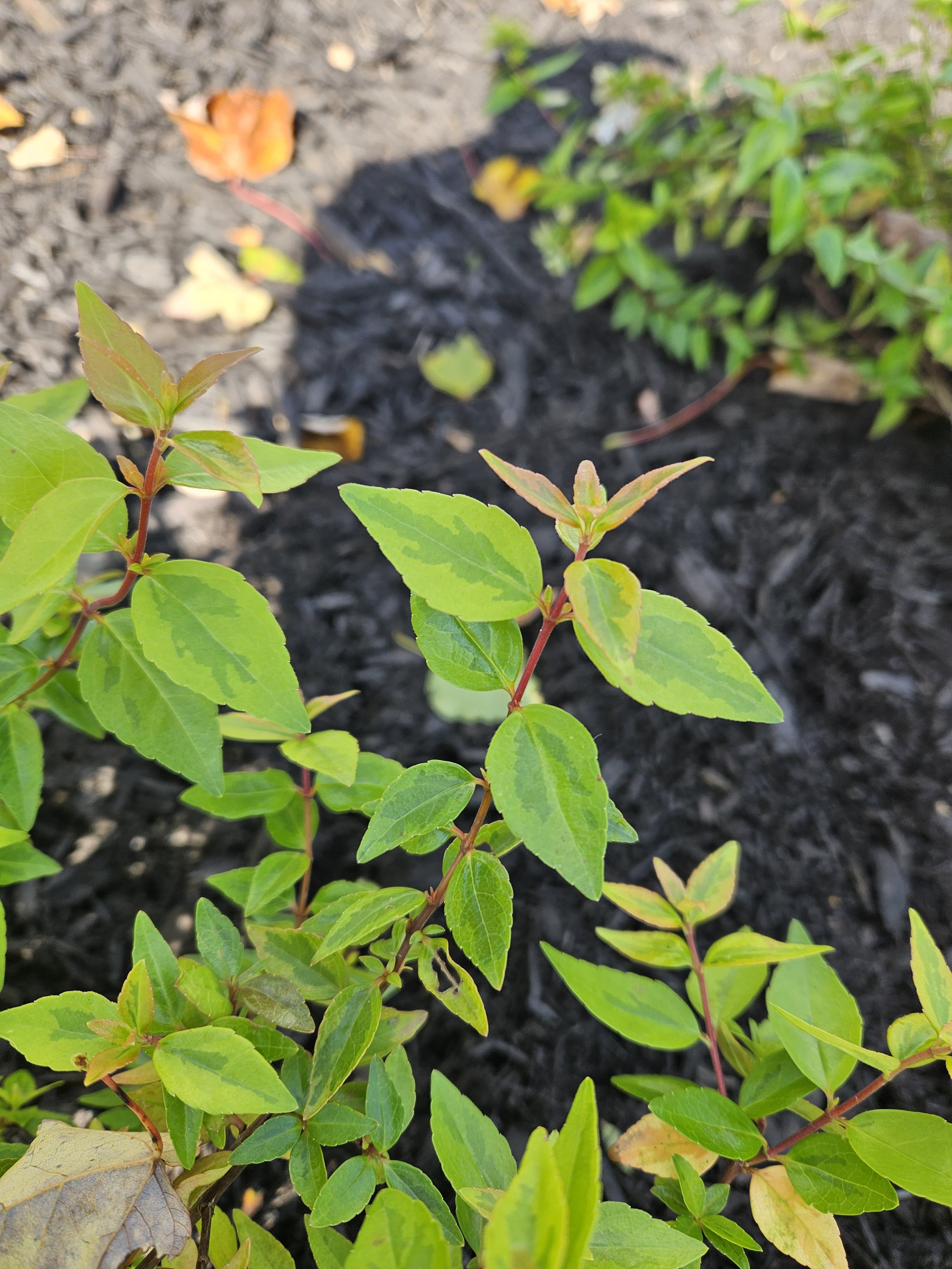
In spring, the foliage emerges with bright green centers surrounded by golden-yellow margins. As summer progresses, the variegation develops warmer gold tones. With the arrival of cooler temperatures, the leaves transition into an extraordinary combination of orange, red, yellow, and green.
Adding to its ornamental value, Kaleidoscope produces small, fragrant, white tubular flowers from summer into fall. These delicate flowers attract pollinators and provide a soft contrast to the colorful foliage.
Its compact, naturally mounding habit makes it an excellent choice for foundation plantings, garden borders, low hedges, mass plantings, containers, and mixed perennial gardens.
For gardeners seeking a shrub that provides interest beyond its flowering period, Kaleidoscope Abelia is an excellent example of how foliage can become the main attraction in a garden.
Why We Grow It at 19 Birch Lane
As we continue developing the gardens at 19 Birch Lane, one of our guiding principles is to choose plants that contribute something meaningful throughout the growing season.
Kaleidoscope Abelia demonstrates this beautifully.
Its changing foliage creates visual interest long before the flowers appear, and that interest continues well into autumn.
This is especially valuable when designing gardens around seasonal transitions.
During spring, the bright yellow and green foliage provides contrast against emerging perennials and darker evergreen shrubs.
In summer, the warm golden tones complement blue and purple flowers such as Catmint, Salvia, and Russian Sage.
By fall, Kaleidoscope becomes an entirely different-looking shrub as orange and red tones emerge.
From a botanical garden perspective, Kaleidoscope also provides an opportunity to teach visitors about:
Variegated foliage
Seasonal foliage color
Plant selection for four-season interest
Compact shrub design
Pollinator-friendly flowering shrubs
Cold-climate plant performance
The relationship between sunlight and foliage coloration
How foliage can influence the appearance of surrounding plants
Kaleidoscope is an excellent example of why we believe a well-designed garden should be interesting even when very little is flowering.
Quick Facts
Common Name: Kaleidoscope Abelia
Botanical Name: Abelia × grandiflora ‘Kaleidoscope’
Family: Caprifoliaceae
Plant Type: Semi-Evergreen Flowering Shrub
USDA Hardiness Zones: 6–9
Mature Height: Approximately 2–3 feet
Mature Width: Approximately 3–5 feet
Growth Habit: Dense, Compact, Mounding, Spreading
Growth Rate: Moderate
Flower Color: White
Flower Buds: Pink-Tinted
Bloom Time: Summer into Fall
Flower Form: Small, Tubular to Bell-Shaped
Flower Fragrance: Lightly Fragrant
Spring Foliage: Green with Bright Yellow Margins
Summer Foliage: Green and Golden Yellow
Fall Foliage: Orange, Red, Gold, and Green
Winter Foliage: Semi-Evergreen in Mild Climates; Often Deciduous in Colder Areas
Sun Exposure: Full Sun to Part Shade
Water Requirements: Moderate During Establishment
Drought Tolerant: Yes, Once Established
Soil: Well-Drained
Maintenance: Low
Pruning: Late Winter to Early Spring
Pollinator Value: Good
Attracts: Bees and Butterflies
Deer Resistance: Generally Resistant
Container Plant: Excellent
Foundation Plant: Excellent
Low Hedge: Excellent
Mass Planting: Excellent
Growing Conditions
Light Requirements
Kaleidoscope Abelia performs best in:
Full Sun
Part Sun
Partial Shade
For the most vibrant foliage coloration, full sun is preferred.
Sunlight intensifies the golden-yellow foliage in summer and encourages the development of stronger orange and red coloration during autumn.
Plants grown in partial shade can still perform well, although the foliage may be less colorful and flowering may be reduced.
For Midcoast Maine, a sunny location protected from harsh winter winds offers an especially favorable combination.
Soil Requirements
Kaleidoscope prefers soil that is:
Well-drained
Moderately fertile
Rich in organic matter
Moist during establishment
Not consistently waterlogged
Although it performs particularly well in slightly acidic soil, it can adapt to a range of soil conditions when drainage is adequate.
Good drainage becomes especially important in colder northern climates, where wet winter soil can contribute to root stress.
Water Requirements
Kaleidoscope has moderate watering needs during establishment.
New plants should receive regular, deep watering until their root systems become established.
Once established, Kaleidoscope demonstrates good drought tolerance.
However, prolonged periods of dry weather can still cause stress, particularly in newly planted shrubs or container-grown specimens.
A layer of organic mulch helps maintain more consistent soil moisture.
Flower Characteristics
Although Kaleidoscope is primarily grown for its foliage, its flowers are an attractive additional feature.
Flower Features
Small, tubular to bell-shaped flowers
White petals
Pink-tinted flower buds
Light fragrance
Summer-to-fall flowering
Attractive to pollinating insects
Delicate appearance against colorful foliage
The flowers appear along the outer portions of the branches, adding another layer of detail without overwhelming the colorful leaves.
Foliage Characteristics
The foliage is what makes Kaleidoscope truly distinctive.
Spring Foliage
New leaves emerge with bright green centers and yellow margins.
The contrast creates a fresh, luminous appearance early in the growing season.
Summer Foliage
The yellow margins deepen toward rich gold while the centers remain green.
This combination is particularly attractive when planted near blue, purple, or dark-leaved plants.
Fall Foliage
As temperatures cool, the foliage develops increasingly warm shades of:
Orange
Red
Golden Yellow
Green
The resulting color combination gives the cultivar its name: Kaleidoscope.
Winter Foliage
In warmer climates, the colorful foliage can remain through much of winter.
In Maine, Kaleidoscope is more likely to lose much or all of its foliage, particularly following colder weather.
It should not be relied upon as a fully evergreen shrub in Zone 6.
Cold Hardiness in Maine
Kaleidoscope Abelia is generally recommended for USDA Zones 6–9 as a landscape shrub.
This makes it a possible choice for the milder portions of coastal and Midcoast Maine, including appropriately protected Zone 6 gardens.
However, its cold hardiness requires more consideration than that of shrubs rated for Zones 3 or 4.
In colder winters, Kaleidoscope may experience:
Partial foliage loss
Complete winter defoliation
Branch dieback
Reduced shrub size
Delayed spring recovery
For Maine gardens, consider:
A sunny, sheltered location
Protection from prevailing winter winds
Well-drained soil
Organic mulch over the root zone
Avoiding exposed sites
Waiting until spring growth begins before removing questionable stems
Kaleidoscope may survive colder conditions by regrowing from its base, but that is different from maintaining an attractive, permanent woody framework.
For 19 Birch Lane, I would treat Kaleidoscope as a shrub that deserves a favorable microclimate rather than a plant for the most exposed areas of the property.
Pollinator & Wildlife Benefits
Kaleidoscope produces small flowers that provide nectar resources for visiting insects.
Pollinators may include:
Bees
Butterflies
Other nectar-feeding insects
Because its flowering season can extend into fall, Kaleidoscope can contribute to the garden during a period when some spring and early-summer plants have finished blooming.
Its dense branching structure can also provide limited shelter for small wildlife.
Although it is not a North American native species, it can still contribute nectar resources within a diverse ornamental planting.
For gardens designed primarily around native biodiversity, combine Kaleidoscope with regionally appropriate native flowering plants.
Deer Resistance & Environmental Tolerance
Kaleidoscope is generally considered deer resistant.
It is also valued for:
Drought tolerance after establishment
Heat tolerance
Adaptability to different soil textures
Low maintenance
Urban landscape suitability
Use on slopes and banks
Deer resistance should not be interpreted as deer-proof.
Browsing pressure varies with local conditions and food availability.
Garden Uses
Kaleidoscope is exceptionally versatile because of its compact size and colorful foliage.
Recommended Uses
Foundation Plantings
Mixed Shrub Borders
Perennial Gardens
Low Informal Hedges
Mass Plantings
Container Gardens
Patio Plantings
Garden Entrances
Pathway Borders
Rock Gardens with Suitable Soil
Slopes and Banks
Color-Themed Gardens
Pollinator-Friendly Gardens
Small Gardens
Botanical Collections
Using Kaleidoscope as a Low Hedge
Its naturally compact, mounding growth habit makes Kaleidoscope particularly effective as a low informal hedge.
A repeated row can create:
Consistent landscape structure
Bright spring color
Golden summer foliage
Warm fall color
Delicate seasonal flowers
Unlike traditional evergreen hedges, Kaleidoscope changes considerably throughout the season.
In Maine, however, winter dieback may interrupt the uniform appearance of a hedge. For this reason, it is better suited to an ornamental low hedge than an essential year-round privacy screen.
Using Kaleidoscope in Foundation Plantings
At approximately 2–3 feet tall and 3–5 feet wide, Kaleidoscope is an excellent candidate for foundation plantings where adequate space is available.
Its compact height can work well beneath appropriately positioned windows or along lower building foundations.
Allow sufficient space for the shrub to develop its natural spreading form.
Avoid planting too close to walls or walkways simply because the nursery plant appears small.
Companion Plants
Kaleidoscope works especially well with plants that contrast with its bright foliage.
Recommended Companions for 19 Birch Lane
Hardy Geranium
Ninebark
Boxwood
Heuchera
Purple and blue flowers are particularly effective alongside the golden summer foliage.
Plants with dark burgundy leaves can also create strong contrast.
Care & Maintenance
Kaleidoscope is considered a low-maintenance shrub when planted in suitable conditions.
Its primary maintenance requirements include:
Regular watering during establishment
Maintaining good drainage
Spring inspection for winter damage
Occasional shaping
Mulching
Avoiding excessive fertilization
Removing unusual vigorous shoots that differ from the cultivar's normal variegated growth
Pruning Kaleidoscope Abelia
When Should Kaleidoscope Be Pruned?
The preferred pruning period is late winter to early spring, particularly in colder climates.
Kaleidoscope flowers on new growth, so spring pruning generally does not eliminate the coming season's flowering display.
For Maine gardens, wait until winter damage can be assessed.
Remove dead or damaged branches and allow new growth to develop.
How to Prune Kaleidoscope
Inspect the shrub after winter.
Remove dead or damaged stems.
Remove crossing or weak branches.
Lightly shape the shrub if necessary.
Preserve its natural mounding habit.
Avoid repeatedly shearing the plant into a rigid shape.
Its naturally rounded form is one of its strongest ornamental characteristics.
Fertilizing
Kaleidoscope generally does not require heavy fertilization.
If soil conditions warrant feeding, apply an appropriate slow-release shrub fertilizer in spring according to the product directions.
Excessive nitrogen can encourage unnecessary vegetative growth.
Healthy soil and correct growing conditions are more important than frequent fertilizer applications.
Landscape Design Ideas
Kaleidoscope is especially effective when used as a foliage contrast plant.
Golden Foliage Combination
Kaleidoscope + Purple Catmint + Blue Salvia + Silver Artemisia
This creates a cool-and-warm color contrast during summer.
Fall Color Combination
Kaleidoscope + Sedum ‘Autumn Joy’ + Ornamental Grasses + Japanese Anemone
As the abelia develops orange and red foliage, the surrounding perennials contribute late-season flowers and texture.
Structural Garden Combination
Kaleidoscope + Boxwood + Ninebark + Hydrangea
This combines colorful foliage with stronger shrub forms and seasonal flowering.
Repeated Border Planting
Plant Kaleidoscope in groups of three or five, allowing enough room for its mature spread.
Repeating the same foliage color through a border can visually connect otherwise separate planting areas.
Why Gardeners Love Kaleidoscope Abelia
✓ Color-changing foliage
✓ Golden-yellow spring and summer leaves
✓ Orange and red autumn color
✓ Fragrant white flowers
✓ Long flowering season
✓ Attractive to bees and butterflies
✓ Compact mounding habit
✓ Excellent foundation shrub
✓ Useful low hedge
✓ Beautiful container plant
✓ Drought tolerant once established
✓ Generally deer resistant
✓ Low maintenance
✓ Strong foliage contrast
✓ Excellent for small gardens
✓ Suitable for sheltered Zone 6 locations
✓ Multi-season ornamental value
Plant Finder Details
Common Name: Kaleidoscope Abelia
Botanical Name: Abelia × grandiflora ‘Kaleidoscope’
Alternative Botanical Classification: Linnaea × grandiflora ‘Kaleidoscope’
Family: Caprifoliaceae
Plant Type: Semi-Evergreen to Deciduous Flowering Shrub
Origin: Cultivated selection of hybrid glossy abelia
USDA Hardiness Zones: 6–9 for reliable woody-shrub performance
Mature Height: Approximately 2–3 feet
Mature Spread: Approximately 3–5 feet
Growth Habit: Dense, Compact, Mounding
Growth Rate: Moderate
Sun Exposure: Full Sun to Part Shade
Water Requirements: Moderate During Establishment
Soil Preference: Well-Drained, Moderately Fertile
Bloom Season: Summer through Fall
Flower Color: White
Flower Bud Color: Pink-Tinted
Flower Shape: Tubular/Bell-Shaped
Flower Fragrance: Lightly Fragrant
Spring Foliage: Green and Yellow
Summer Foliage: Green and Gold
Fall Foliage: Orange, Red, Yellow, and Green
Winter Interest: Foliage in Mild Climates
Pollinator Value: Good
Attracts: Bees and Butterflies
Deer Resistance: Generally Resistant
Drought Tolerance: Good Once Established
Pruning: Late Winter to Early Spring
Foundation Planting: Excellent
Low Hedge: Excellent
Container Planting: Excellent
Mass Planting: Excellent
📍 Where to Find Kaleidoscope Abelia at 19 Birch Lane
Kaleidoscope would be particularly well suited to a sunny mixed shrub border, foundation planting, protected garden entrance, or another location where visitors can observe its changing foliage throughout the growing season.
Its relatively compact size also makes it an interesting candidate for areas where larger flowering shrubs would overwhelm neighboring plants.
🌸 Seasonal Interest Calendar
🌱 Spring
New foliage emerges in bright green and golden yellow.
The shrub begins developing its dense, mounding growth habit.
☀️ Early Summer
Golden-yellow foliage becomes increasingly prominent.
Pink-tinted flower buds begin developing.
🤍 Summer
Small fragrant white flowers appear among the colorful foliage.
Bees and butterflies may visit the blooms.
🌿 Late Summer
The shrub continues flowering while maintaining its golden variegated foliage.
🍂 Fall
This is one of Kaleidoscope's most colorful seasons.
Leaves develop shades of orange, red, gold, and green.
❄️ Winter
In mild climates, foliage may remain colorful through winter.
In Maine, expect significant foliage loss and possible branch dieback following colder weather.
🎓 Garden Design Tips from 19 Birch Lane
Kaleidoscope illustrates a principle that becomes increasingly important as a garden matures:
Foliage should be treated as a primary design element, not simply a background for flowers.
Flowers are often temporary.
Foliage can contribute color, texture, and structure for months.
One combination we would consider is:
Kaleidoscope + Catmint + Salvia + Artemisia
The golden foliage creates contrast with purple and blue flowers while the silver Artemisia provides a softer transition.
For autumn:
Kaleidoscope + Sedum ‘Autumn Joy’ + Ornamental Grasses + Japanese Anemone
This combination allows the border to develop warmer tones as the season progresses.
For a more formal composition, repeat Kaleidoscope at regular intervals among dark green structural shrubs.
The repetition creates rhythm while the changing foliage introduces seasonal movement.
🌿 Plants That Grow Well with Kaleidoscope Abelia at 19 Birch Lane
Recommended companions include:
Catmint
Salvia
Coneflower
Russian Sage
Sedum ‘Autumn Joy’
Japanese Anemone
Hardy Geranium
Daylilies
Irises
Ninebark
Ornamental Grasses
Boxwood
Hydrangeas
Heuchera
Artemisia
Where these plants already have corresponding Plant Finder entries, their names should become contextual internal links.
This helps visitors discover plants with complementary growing conditions and design characteristics while strengthening the interconnected structure of the 19 Birch Lane Plant Finder.
Frequently Asked Questions
What is Kaleidoscope Abelia?
Kaleidoscope is a compact, variegated selection of glossy abelia known for colorful foliage that changes from green and gold to orange and red as the season progresses.
What is the botanical name of Kaleidoscope Abelia?
It is commonly listed as Abelia × grandiflora ‘Kaleidoscope’. The botanical name Linnaea × grandiflora ‘Kaleidoscope’ also appears in horticultural references.
How big does Kaleidoscope Abelia get?
It typically grows approximately 2–3 feet tall and 3–5 feet wide, depending on climate and growing conditions.
Is Kaleidoscope Abelia evergreen?
It is generally semi-evergreen in mild climates but may become deciduous in colder regions.
Does Kaleidoscope Abelia lose its leaves in winter?
Yes, it may lose most or all of its leaves in colder climates, including Maine.
What color is Kaleidoscope Abelia?
Its foliage changes throughout the year, beginning green and yellow, becoming golden in summer, and developing orange and red tones in fall.
Does Kaleidoscope Abelia flower?
Yes. It produces small, fragrant white flowers, often from summer into fall.
Does Kaleidoscope Abelia attract pollinators?
Yes. Its flowers attract bees, butterflies, and other nectar-feeding insects.
Does Kaleidoscope Abelia need full sun?
Full sun produces the strongest foliage color and flowering, but it also tolerates partial shade.
Can Kaleidoscope Abelia grow in Maine?
It can grow in appropriately sheltered Zone 6 locations, but winter foliage loss and branch dieback are possible. It is less dependable in colder or highly exposed Maine gardens.
Is Kaleidoscope Abelia hardy in Zone 6?
Yes, Zone 6 is within its commonly recommended range, although performance depends on winter conditions and planting location.
Is Kaleidoscope Abelia drought tolerant?
Yes. Established plants demonstrate good drought tolerance, although regular watering is important during establishment.
Is Kaleidoscope Abelia deer resistant?
It is generally considered deer resistant, but no shrub is completely immune to browsing.
When should Kaleidoscope Abelia be pruned?
Late winter to early spring is an excellent pruning period, especially where winter damage may occur.
Does Kaleidoscope Abelia bloom on new wood?
Yes. It flowers on new growth, making spring pruning a practical maintenance option.
Is Kaleidoscope Abelia good for foundation planting?
Yes. Its compact size and colorful foliage make it an excellent foundation shrub where winter hardiness is adequate.
Can Kaleidoscope Abelia be grown in containers?
Yes. Its naturally compact growth habit makes it suitable for larger patio containers. In cold climates, container roots require additional winter protection.
What plants look good with Kaleidoscope Abelia?
Catmint, Salvia, Coneflower, Russian Sage, Sedum, Japanese Anemone, Ornamental Grasses, Ninebark, Boxwood, and Hydrangeas are attractive companions.
Botanical Garden Notes
Kaleidoscope has an interesting horticultural origin.
It was discovered in 1997 as a naturally occurring variegated branch sport of Abelia × grandiflora ‘Little Richard’ at a nursery in North Carolina.
The cultivar was selected for its unusually colorful foliage and naturally dense, compact growth habit.
Its original U.S. plant patent, PP16,988, was granted in 2006.
The cultivar's defining characteristics include:
Variegated green and yellow foliage
Orange and red autumn coloration
Reddish-purple stems
Compact mounding habit
Fragrant white flowers
Strong seasonal foliage interest
This makes Kaleidoscope an excellent teaching plant for explaining the horticultural concept of a branch sport.
A branch sport occurs when part of a plant develops a naturally occurring genetic variation, sometimes producing foliage or flowers that differ from the rest of the plant.
When that variation is stable and desirable, horticulturists may propagate it to establish a new cultivar.
Kaleidoscope is a particularly attractive example of how plant selection can create new ornamental possibilities without conventional crossbreeding.
For the 19 Birch Lane Plant Finder, that history adds educational value beyond a simple description of the plant's appearance.
For more great information check out our blog called In the Garden at 19 Birch Lane